Fisheye Fun at Doors Open Toronto

Doors Open in Toronto is an annual weekend event where the public are allowed into historic, unique, and otherwise culturally significant buildings, or at least parts of those buildings, that would normally be closed to them. Depending on the building, visitors are then able to go on either guided or "self-guided" tours. The latter is what interested me most, as to have the freedom to explore on my own might offer more photographic opportunities and room to experiment. I was also looking specifically for big interiors that only a fisheye lens can capture in full.
Fisheye lenses can be controversial, often seen as little more than a gimmick among photographers (and I assume that architects disapprove of them as well), and I must admit I almost gave up on mine after the first year. It is possible to make fantastic photos with them but it can be more challenging, especially in urban environments with so many straight lines. But with Doors Open, I envisioned fisheye as a way to both highlight and accentuate the grandeur and majesty of certain buildings, especially their spacious and extravagant interiors and high ceilings.
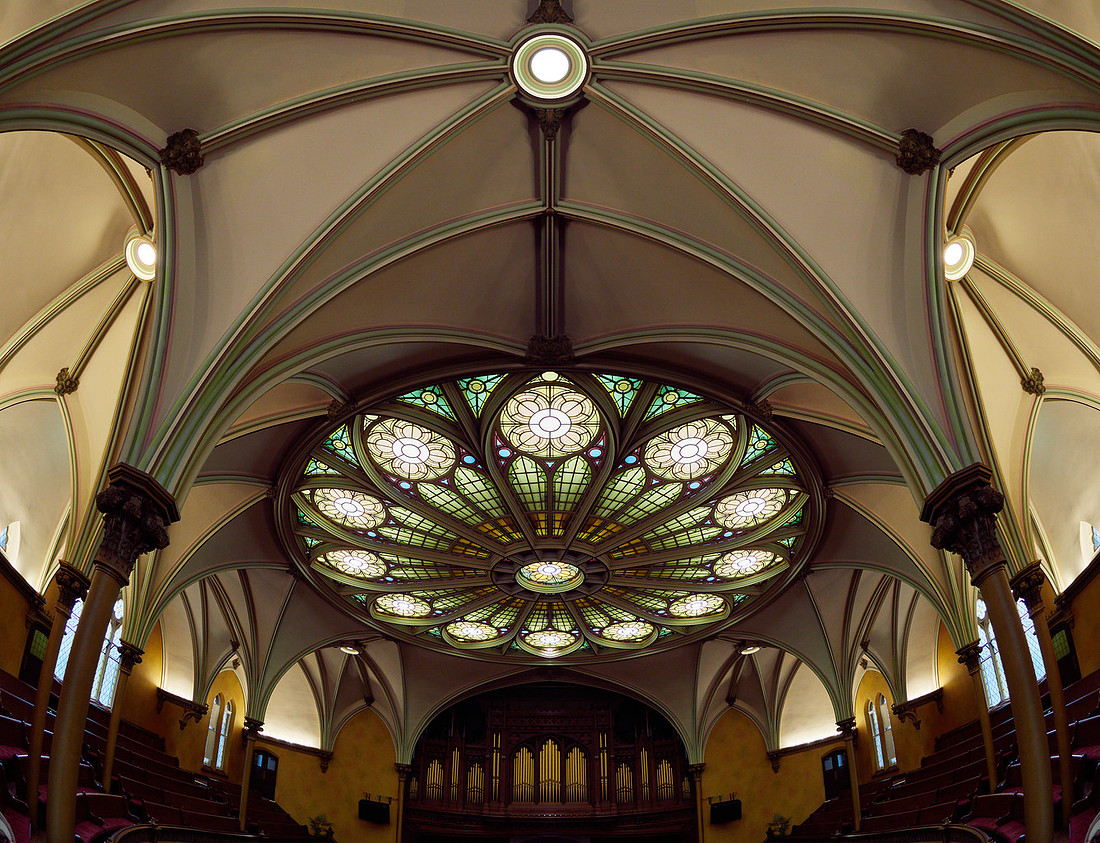 Jarvis Street Baptist ChurchThis ceiling already has many curved elements, and the fisheye effect only accentuates the curves, and as a result the distortion is less noticeable.
 Contrary to popular belief, fisheye lenses do not cause more distortion than rectilinear ultra-wide angle (UWA) lenses; they merely cause a different type of distortion. Whereas rectilinear UWA lenses distort the distances of objects away from the centre of the frame in order to preserve linearity, fisheye lenses distort linearity in order to maintain an accurate representation of those distances. This is similar to cartography, where the surface of Earth (an oblate spheroid) is projected onto a 2-D plane, and cartographers must choose which characteristics (distance, area, direction) they want to keep true and which they are willing to distort. For example, the commonly-used Mercator projection exaggerates the sizes of places near the poles in order to present lines of longitude and latitude as straight lines. By choosing between fisheye or rectilinear UWA, photographers are likewise choosing between two different types of projections.
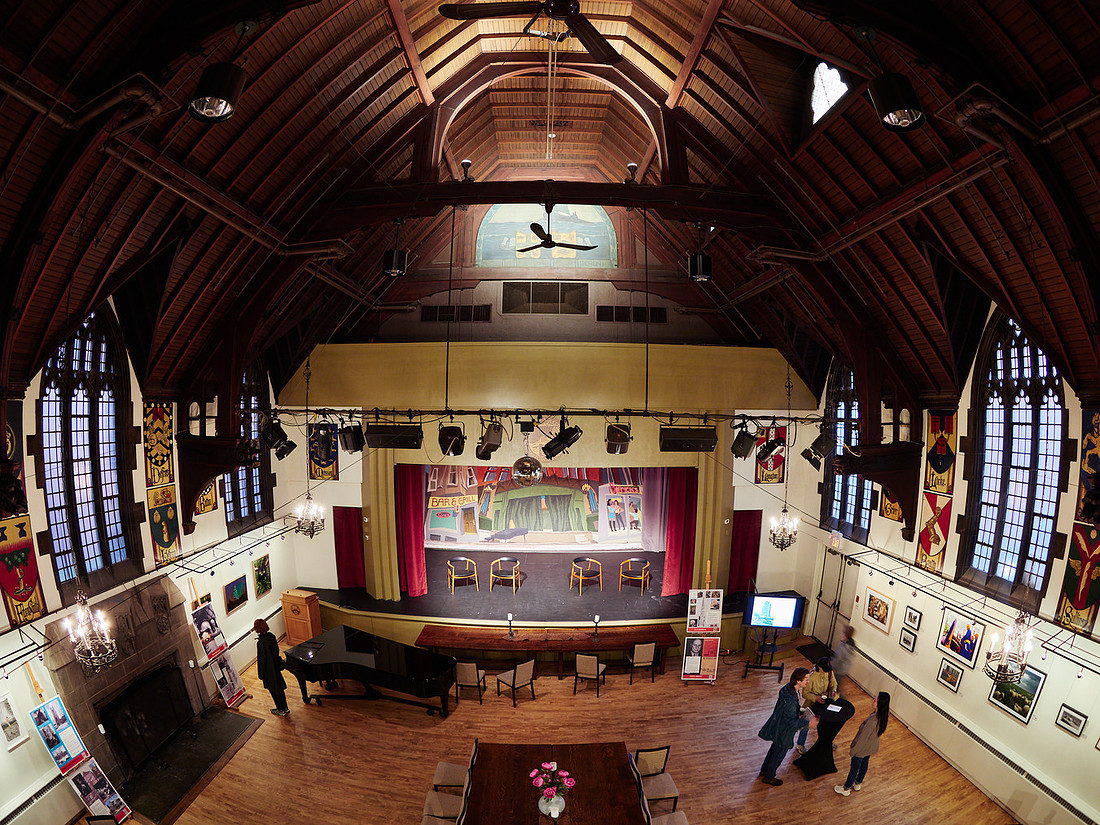 Arts and Letters Club 5By keeping my camera as level as possible and pointing it straight ahead, lines converge toward a central point in the unseen distance and remain straight. The light bar hanging in the centre of the frame also remains straight.
One important thing to keep in mind when using fisheye lenses is that they do not distort all of the lines. If they are straight, then the vertical and horizontal lines in the centre of the frame will remain straight, as will the diagonals converging toward the centre. Therefore, keeping things centred in the frame can help to minimize distortion. For these particular photos, this often meant keeping my camera as level as possible and carefully placing myself in the centre of the room, balcony, aisle, or hallway. Having a perfectly straight line—either horizontal, vertical, or both—will provide an anchor for the viewer. Many straight lines converging towards the centre will not only help to anchor the image, they will also lead the viewer into the scene, towards the least distorted part of the image. In this case, it might be helpful to place the main subject the centre of the frame, contrary to the "Rule of Thirds."
Arts and Letters Club 5By keeping my camera as level as possible and pointing it straight ahead, lines converge toward a central point in the unseen distance and remain straight. The light bar hanging in the centre of the frame also remains straight.
One important thing to keep in mind when using fisheye lenses is that they do not distort all of the lines. If they are straight, then the vertical and horizontal lines in the centre of the frame will remain straight, as will the diagonals converging toward the centre. Therefore, keeping things centred in the frame can help to minimize distortion. For these particular photos, this often meant keeping my camera as level as possible and carefully placing myself in the centre of the room, balcony, aisle, or hallway. Having a perfectly straight line—either horizontal, vertical, or both—will provide an anchor for the viewer. Many straight lines converging towards the centre will not only help to anchor the image, they will also lead the viewer into the scene, towards the least distorted part of the image. In this case, it might be helpful to place the main subject the centre of the frame, contrary to the "Rule of Thirds."
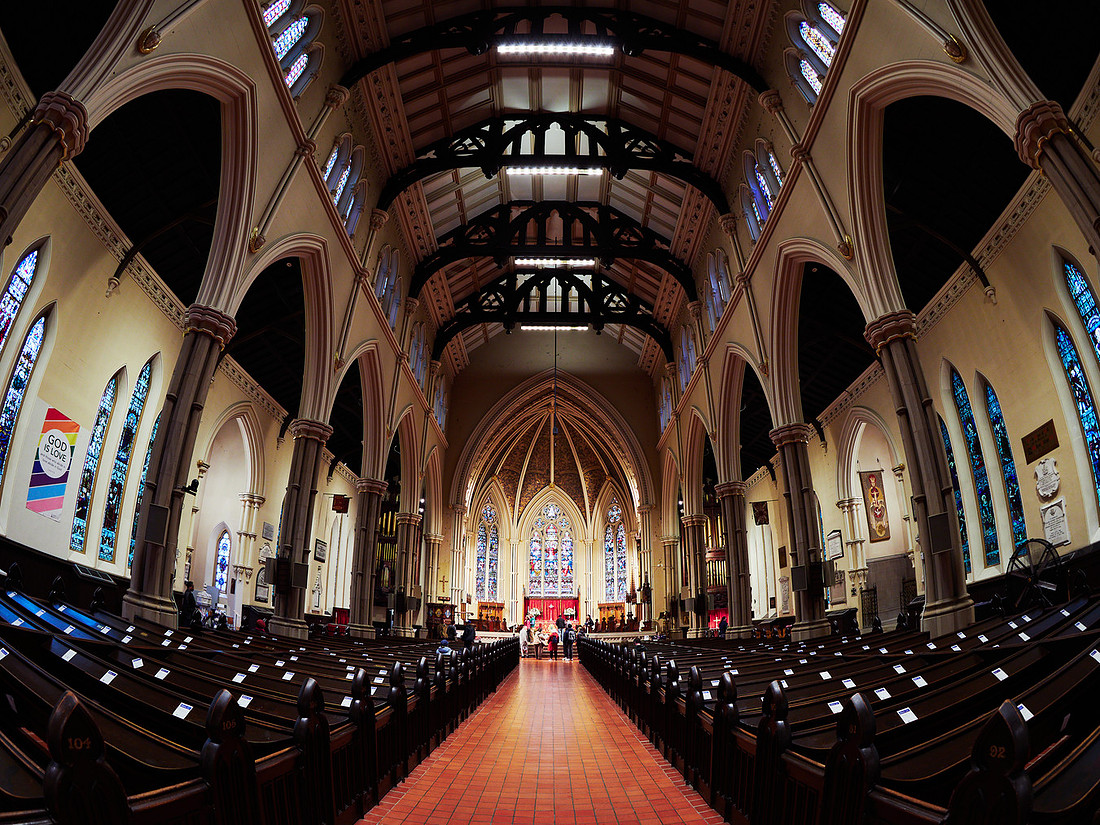 St. James Cathedral 1Carefully placing myself in the middle of the aisle, placing the top of the aspe in the exact centre of the frame, I lead the viewer toward the chancel, which was naturally the brightest part of the room to begin with, and with a fisheye lens it also becomes the least distorted and most real part of the room.
Of course, we do have the option to defish and remove the linear distortion, either in-camera or in post-processing. But doing so, comparing before and after, only made me more aware how distorted and misleading rectilinear ultra-wide angle perspectives can be in their own way. Although fisheye lenses might create images that seem wacky and surreal compared to rectilinear lenses, when used properly the fisheye effect can actually represent the subject and the scene more faithfully and bring the viewer closer to reality. And even if the image does not represent exactly what the viewer would be seeing if they were there, it might better represent what they would be feeling, standing in my shoes. Being able to quickly switch to a live preview of the defished result in-camera makes it much easier to compose and is very helpful in deciding which type of projection is the best for the scene.
St. James Cathedral 1Carefully placing myself in the middle of the aisle, placing the top of the aspe in the exact centre of the frame, I lead the viewer toward the chancel, which was naturally the brightest part of the room to begin with, and with a fisheye lens it also becomes the least distorted and most real part of the room.
Of course, we do have the option to defish and remove the linear distortion, either in-camera or in post-processing. But doing so, comparing before and after, only made me more aware how distorted and misleading rectilinear ultra-wide angle perspectives can be in their own way. Although fisheye lenses might create images that seem wacky and surreal compared to rectilinear lenses, when used properly the fisheye effect can actually represent the subject and the scene more faithfully and bring the viewer closer to reality. And even if the image does not represent exactly what the viewer would be seeing if they were there, it might better represent what they would be feeling, standing in my shoes. Being able to quickly switch to a live preview of the defished result in-camera makes it much easier to compose and is very helpful in deciding which type of projection is the best for the scene.
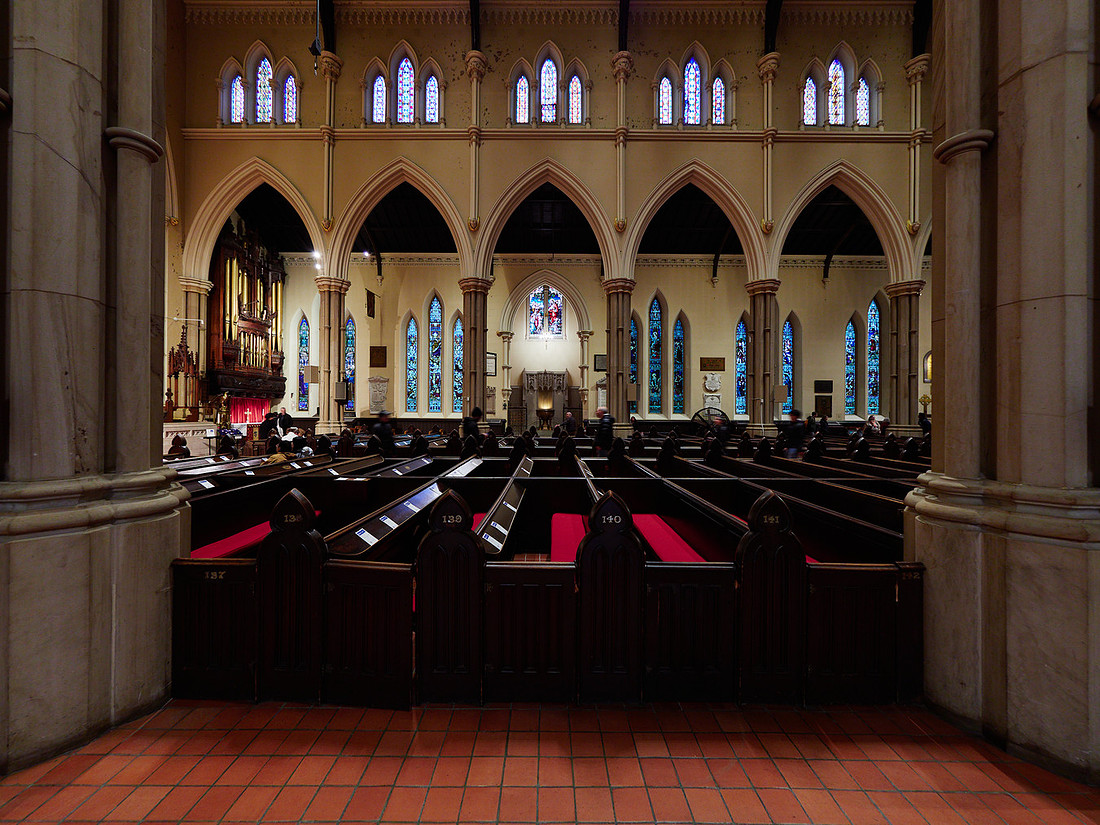 St. James Cathedral 3Defishing preserves are the regular patterns of vertical and horizontal lines which are important to the image. However, this also results in the pillars and tiles at the sides in the foreground becoming stretched out and greatly exaggerated in size.
I visited six buildings in total in downtown Toronto on a very rainy, windy, cold Saturday, May 23. These are the Thorton-Smith Building, St. George's Hall, TMU Architecture Building, Jarvis Street Baptist Church, St. Lawrence Hall, and the St. James Cathedral, in that order. Attending Doors Open is something I've been wanting to do for years but I kept putting it off or forgetting. Despite the weather (and my lack of sleep), I enjoyed the experience and appreciate the opportunity to photograph these places, and I look forward to it again next year. I also look forward to experimenting more with fisheye and I hope that detailing some of my experiences with this lens here will be helpful to others in some way.
St. James Cathedral 3Defishing preserves are the regular patterns of vertical and horizontal lines which are important to the image. However, this also results in the pillars and tiles at the sides in the foreground becoming stretched out and greatly exaggerated in size.
I visited six buildings in total in downtown Toronto on a very rainy, windy, cold Saturday, May 23. These are the Thorton-Smith Building, St. George's Hall, TMU Architecture Building, Jarvis Street Baptist Church, St. Lawrence Hall, and the St. James Cathedral, in that order. Attending Doors Open is something I've been wanting to do for years but I kept putting it off or forgetting. Despite the weather (and my lack of sleep), I enjoyed the experience and appreciate the opportunity to photograph these places, and I look forward to it again next year. I also look forward to experimenting more with fisheye and I hope that detailing some of my experiences with this lens here will be helpful to others in some way.
To see all my photos taken at Doors Open, both fishy and de-fished, visit the gallery page: Doors Open (2026)