Sarnia's Chemical Valley: From East to West
With recent talk of a new pipeline, dubbed the Northern Shield Energy Corridor, from Alberta east to Ontario, terminating at Sarnia to supply the city's oil refineries, I thought it would be a good opportunity to look back at my own little journey in the summer of 2022 from the Toronto area west to Sarnia to photograph these facilities. I didn't realize it at the time, but it was also a journey would end up being long-winded, and also with much risk.
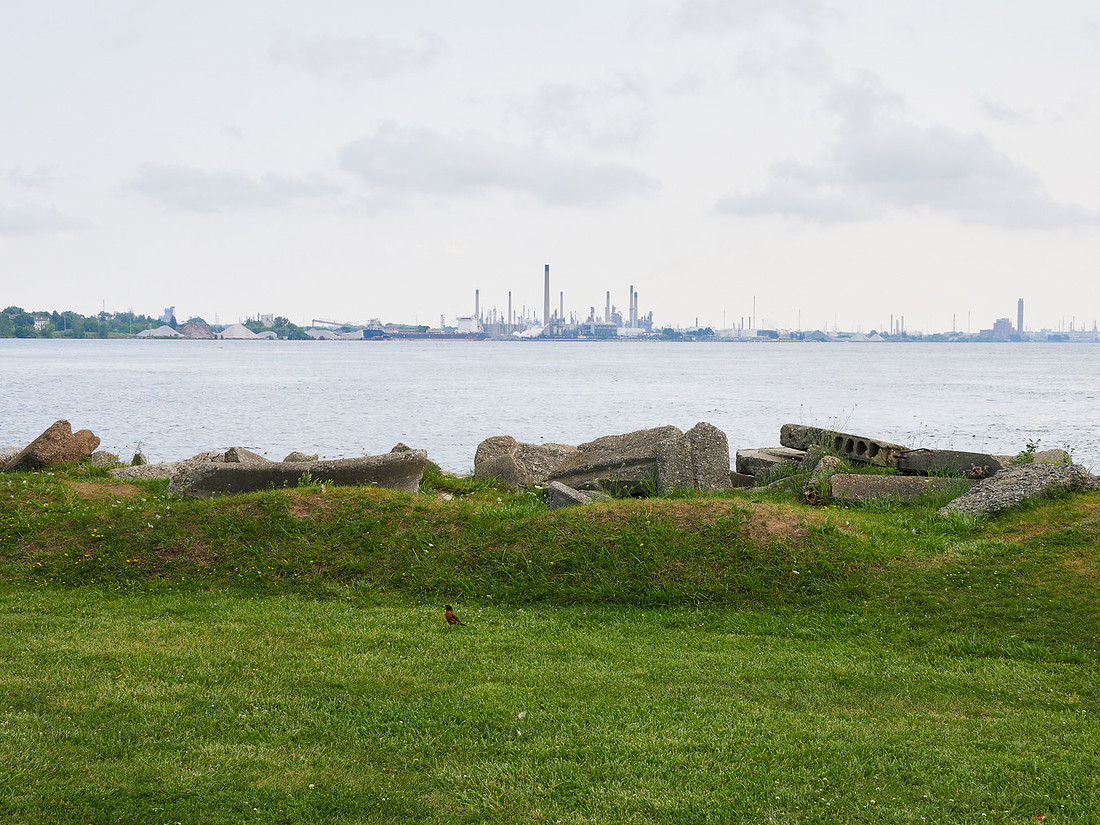 Sarnia: Bayside 25Looking across Sarnia Bay and downstream along the St. Clair River to Chemical Valley.
 I did not journey to Sarnia with a plan to document its oil industry. Its presence in the city is impossible to escape, the giant smokestacks are unmistakable and plainly visible, always looming in the distance downriver from anywhere along Sarnia's waterfront. But somehow I never gave much thought to them, perhaps because of my lack of knowledge about Sarnia's economy. However, when visiting Guthrie Park just outside the city, the presence of Shell Canada's Sarnia Manufacturing Centre looming tall directly across the street behind me was impossible to ignore. Only then did the subject start to pique my interest and give me an idea to do an entire series of photos. I snapped a few pictures, and set out again the very next day on foot to photograph the oil refineries within the city proper.
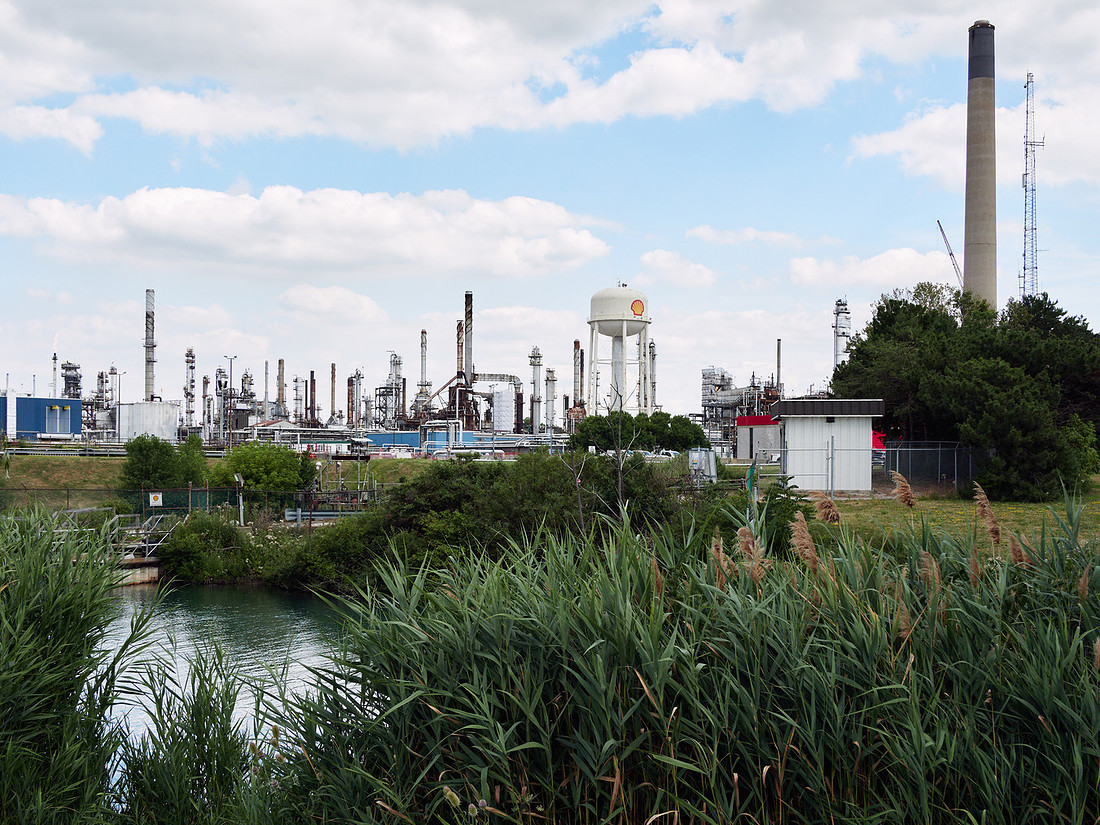
Sarnia's so-called "Chemical Valley" lies on the south end of the city and consists of three oil refineries, one owned by Imperial Oil, another owned by Suncor, and the aforementioned Shell refinery right outside the city limits in Corunna. Together, the Imperial Oil and Suncor refineries encompass approximately eight square kilometres of land, roughly one-eighth of Sarnia's urban area. The sprawling Imperial Oil complex comprises the vast majority of this land, which is the main subject of this series. After spending an hour and a half walking around and taking photos nonstop, I may have been too tired or lazy to walk another 30 minutes down Vidal Street South just to reach the much smaller Suncor refinery.
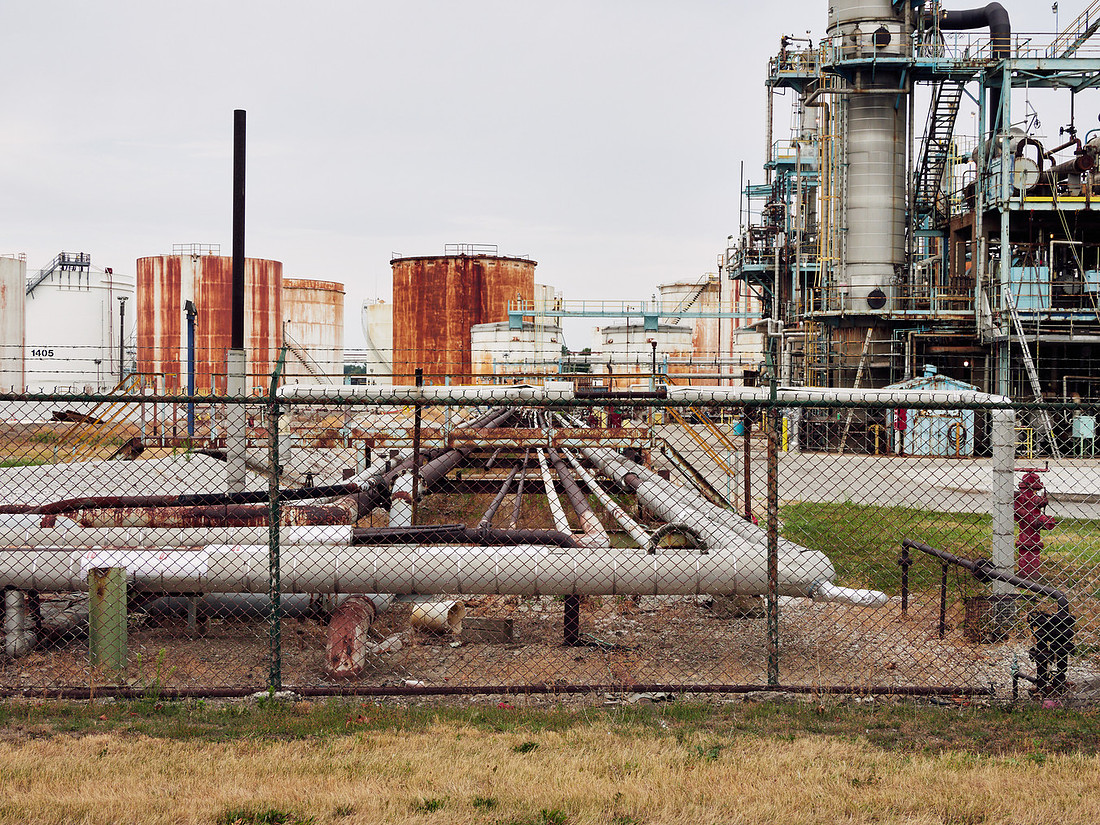 Chemical Valley 14Part of the Imperial Oil refinery along Christina Street South in Sarnia.
Premiers Doug Ford and Danielle Smith have tried to frame their proposed east-west pipeline as in the public interest, but based on my interactions with security guards and police while shooting these photos, I think this pipeline could be as much, if not more, about private interests. Even though I was walking in a public right of way, the security guards followed me in their car for almost an hour before the police finally arrived. Furthermore, shortly after I took these photos, and possibly because I took these photos, Imperial Oil covered up all of the fences to block these facilities from public view. Is reinforcing or even expanding the oil industry in Sarnia in the public interest? It seems that Imperial Oil does not think so.
Chemical Valley 14Part of the Imperial Oil refinery along Christina Street South in Sarnia.
Premiers Doug Ford and Danielle Smith have tried to frame their proposed east-west pipeline as in the public interest, but based on my interactions with security guards and police while shooting these photos, I think this pipeline could be as much, if not more, about private interests. Even though I was walking in a public right of way, the security guards followed me in their car for almost an hour before the police finally arrived. Furthermore, shortly after I took these photos, and possibly because I took these photos, Imperial Oil covered up all of the fences to block these facilities from public view. Is reinforcing or even expanding the oil industry in Sarnia in the public interest? It seems that Imperial Oil does not think so.
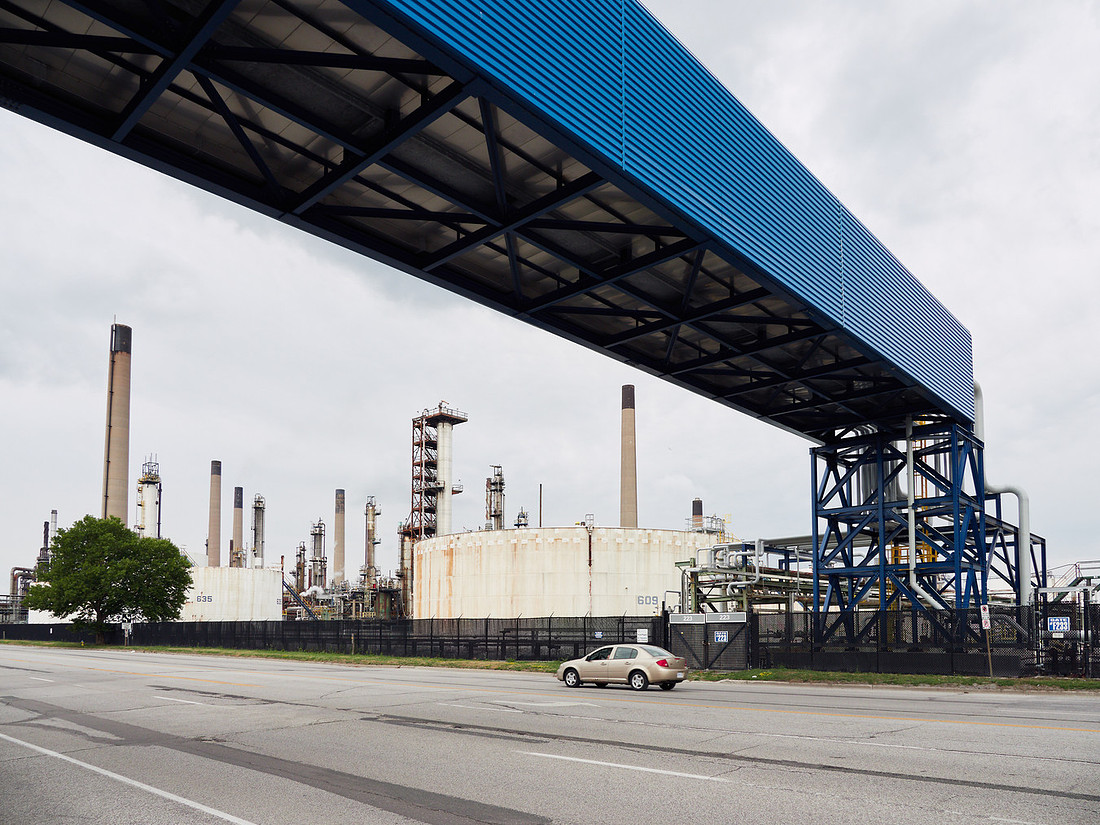 Chemical Valley 25Looking under a pipe bridge along Vidal Street South a few seconds before the police arrived.
The Shell and Suncor refineries can each process up to 85,000 barrels of crude oil per day, while the Imperial Oil refinery can process up to 121,000, for a combined total of 291,000 barrels per day. The new east-west pipeline proposed by the governments of Alberta and Ontario would have a capacity of 500,000 barrels of crude oil per day. Unless these refineries expand or other oil companies start operations in Sarnia, the numbers don't seem to add up.
Chemical Valley 25Looking under a pipe bridge along Vidal Street South a few seconds before the police arrived.
The Shell and Suncor refineries can each process up to 85,000 barrels of crude oil per day, while the Imperial Oil refinery can process up to 121,000, for a combined total of 291,000 barrels per day. The new east-west pipeline proposed by the governments of Alberta and Ontario would have a capacity of 500,000 barrels of crude oil per day. Unless these refineries expand or other oil companies start operations in Sarnia, the numbers don't seem to add up.
I tried to take these photos honestly and objectively, driven primarily by my interest in industrial architecture rather than by any political agenda. After all, these photos were taken over four years ago, well before any of the recent political tensions. But I hope they can give viewers an idea of the scale of Sarnia's oil industry and what the proposed east-west pipeline would serve, and help them decide whether or not it is what Canada needs.
To see all 43 photos in the series, visit the gallery page: Sarnia: Chemical Valley.
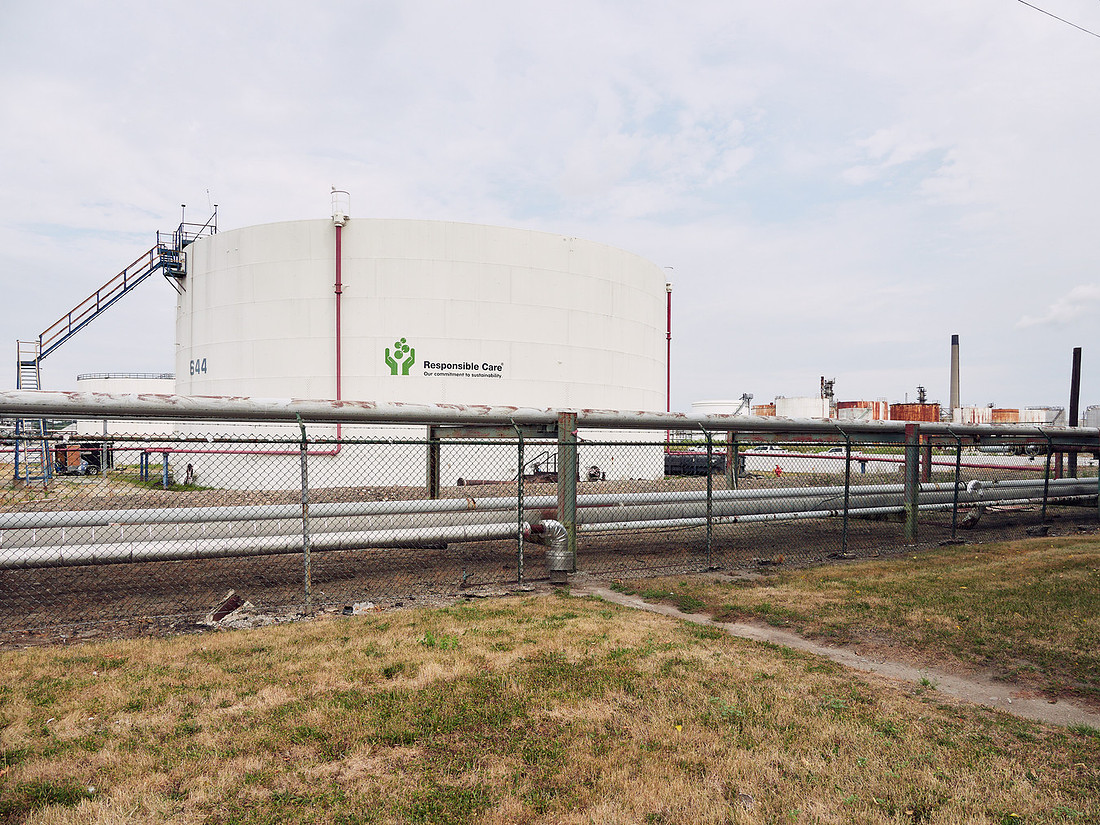 Chemical Valley 19Imperial Oil espouses sustainability along Clifford Street in Sarnia.
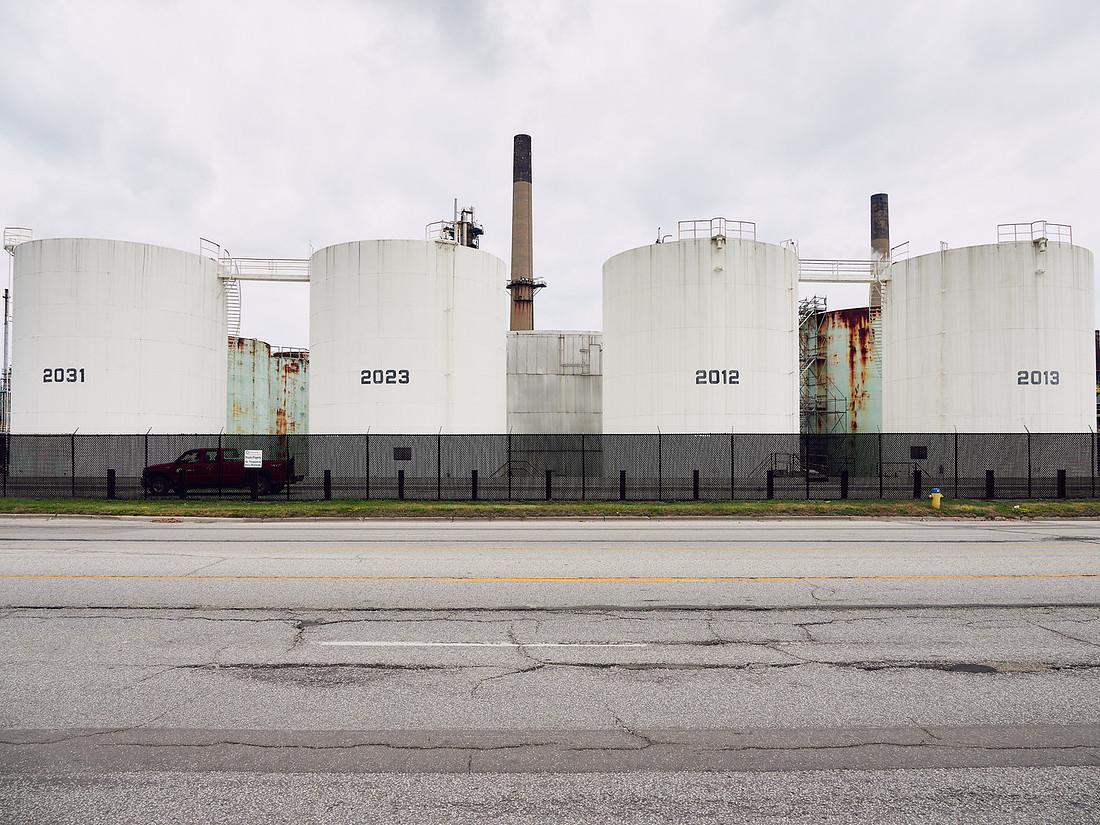 Chemical Valley 32Oil tanks along Vidal Street South in Sarnia.
Fisheye Fun at Doors Open Toronto
Doors Open in Toronto is an annual weekend event where the public are allowed into historic, unique, and otherwise culturally significant buildings, or at least parts of those buildings, that would normally be closed to them. Depending on the building, visitors are then able to go on either guided or "self-guided" tours. The latter is what interested me most, as to have the freedom to explore on my own might offer more photographic opportunities and room to experiment. I was also looking specifically for big interiors that only a fisheye lens can capture in full.
Fisheye lenses can be controversial, often seen as little more than a gimmick among photographers (and I assume that architects disapprove of them as well), and I must admit I almost gave up on mine after the first year. It is possible to make fantastic photos with them but it can be more challenging, especially in urban environments with so many straight lines. But with Doors Open, I envisioned fisheye as a way to both highlight and accentuate the grandeur and majesty of certain buildings, especially their spacious and extravagant interiors and high ceilings.
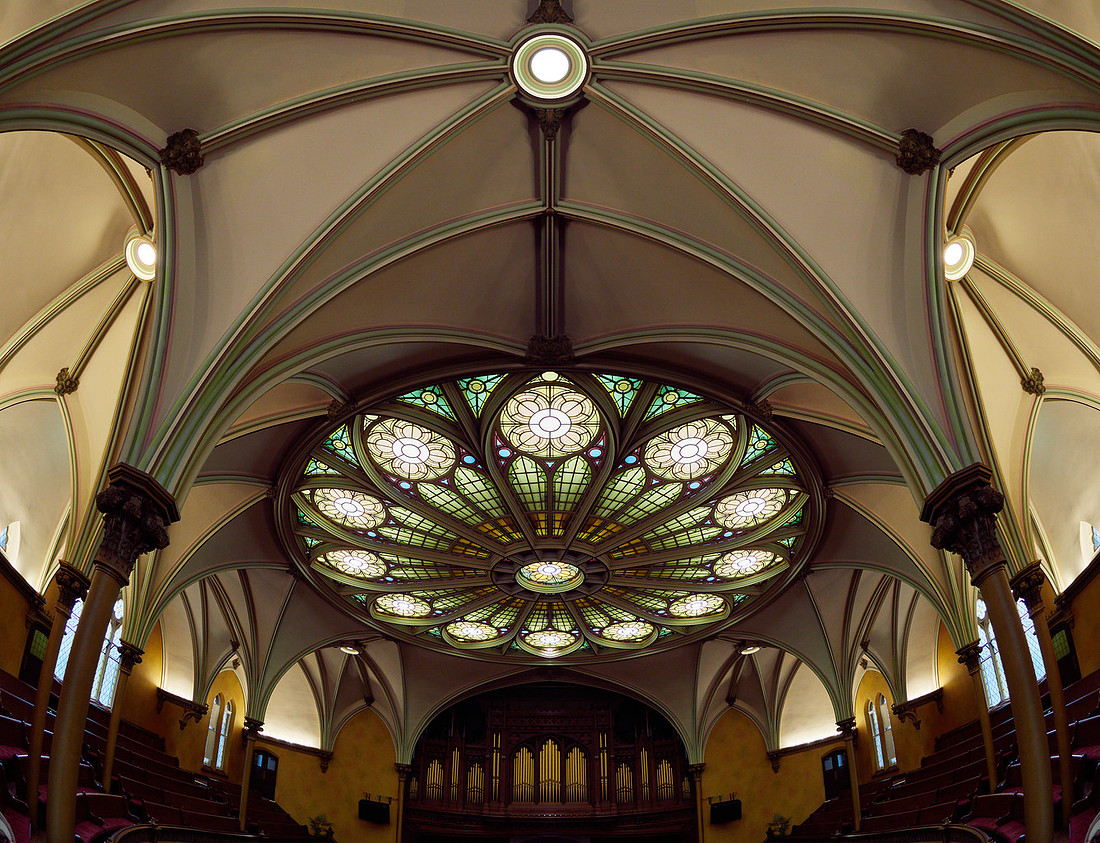 Jarvis Street Baptist ChurchThis ceiling already has many curved elements, and the fisheye effect only accentuates the curves, and as a result the distortion is less noticeable.
Contrary to popular belief, fisheye lenses do not cause more distortion than rectilinear ultra-wide angle (UWA) lenses; they merely cause a different type of distortion. Whereas rectilinear UWA lenses distort the distances of objects away from the centre of the frame in order to preserve linearity, fisheye lenses distort linearity in order to maintain an accurate representation of those distances. This is similar to cartography, where the surface of Earth (an oblate spheroid) is projected onto a 2-D plane, and cartographers must choose which characteristics (distance, area, direction) they want to keep true and which they are willing to distort. For example, the commonly-used Mercator projection exaggerates the sizes of places near the poles in order to present lines of longitude and latitude as straight lines. By choosing between fisheye or rectilinear UWA, photographers are likewise choosing between two different types of projections.
Jarvis Street Baptist ChurchThis ceiling already has many curved elements, and the fisheye effect only accentuates the curves, and as a result the distortion is less noticeable.
Contrary to popular belief, fisheye lenses do not cause more distortion than rectilinear ultra-wide angle (UWA) lenses; they merely cause a different type of distortion. Whereas rectilinear UWA lenses distort the distances of objects away from the centre of the frame in order to preserve linearity, fisheye lenses distort linearity in order to maintain an accurate representation of those distances. This is similar to cartography, where the surface of Earth (an oblate spheroid) is projected onto a 2-D plane, and cartographers must choose which characteristics (distance, area, direction) they want to keep true and which they are willing to distort. For example, the commonly-used Mercator projection exaggerates the sizes of places near the poles in order to present lines of longitude and latitude as straight lines. By choosing between fisheye or rectilinear UWA, photographers are likewise choosing between two different types of projections.
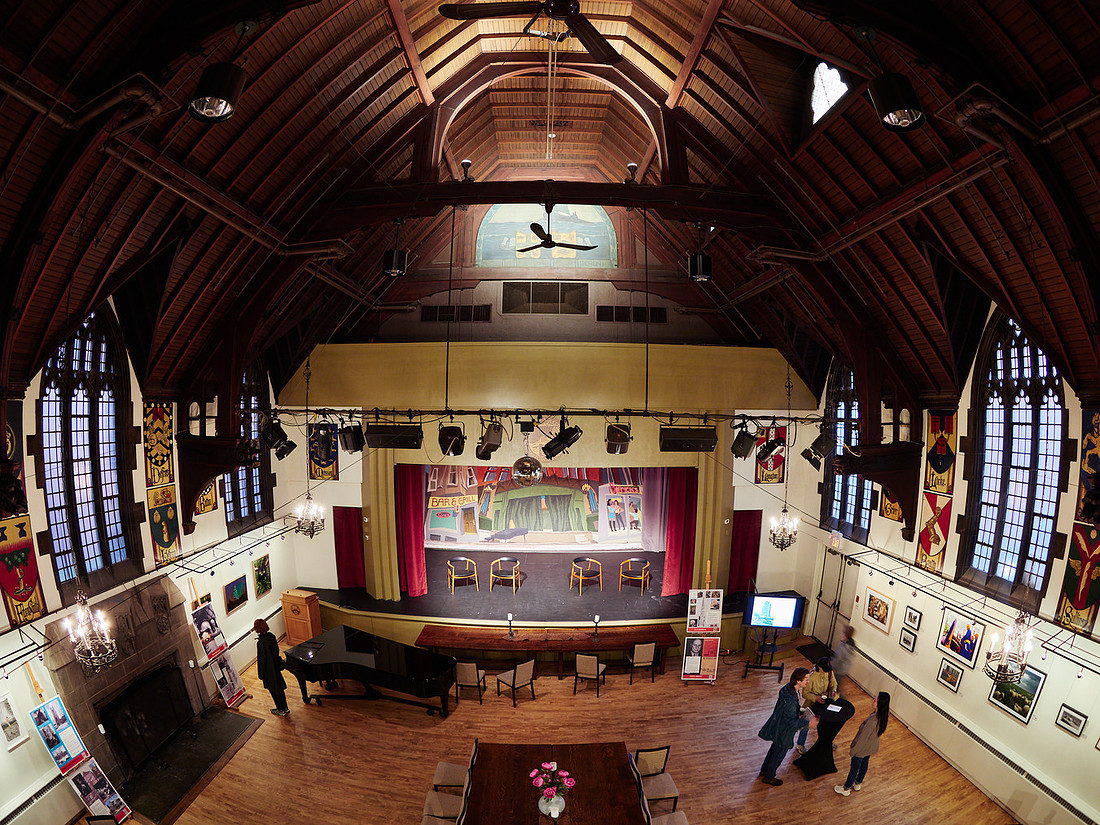 Arts and Letters Club 5By keeping my camera as level as possible and pointing it straight ahead, lines converge toward a central point in the unseen distance and remain straight. The light bar hanging in the centre of the frame also remains straight.
One important thing to keep in mind when using fisheye lenses is that they do not distort all of the lines. If they are straight, then the vertical and horizontal lines in the centre of the frame will remain straight, as will the diagonals converging toward the centre. Therefore, keeping things centred in the frame can help to minimize distortion. For these particular photos, this often meant keeping my camera as level as possible and carefully placing myself in the centre of the room, balcony, aisle, or hallway. Having a perfectly straight line—either horizontal, vertical, or both—will provide an anchor for the viewer. Many straight lines converging towards the centre will not only help to anchor the image, they will also lead the viewer into the scene, towards the least distorted part of the image. In this case, it might be helpful to place the main subject the centre of the frame, contrary to the "Rule of Thirds."
Arts and Letters Club 5By keeping my camera as level as possible and pointing it straight ahead, lines converge toward a central point in the unseen distance and remain straight. The light bar hanging in the centre of the frame also remains straight.
One important thing to keep in mind when using fisheye lenses is that they do not distort all of the lines. If they are straight, then the vertical and horizontal lines in the centre of the frame will remain straight, as will the diagonals converging toward the centre. Therefore, keeping things centred in the frame can help to minimize distortion. For these particular photos, this often meant keeping my camera as level as possible and carefully placing myself in the centre of the room, balcony, aisle, or hallway. Having a perfectly straight line—either horizontal, vertical, or both—will provide an anchor for the viewer. Many straight lines converging towards the centre will not only help to anchor the image, they will also lead the viewer into the scene, towards the least distorted part of the image. In this case, it might be helpful to place the main subject the centre of the frame, contrary to the "Rule of Thirds."
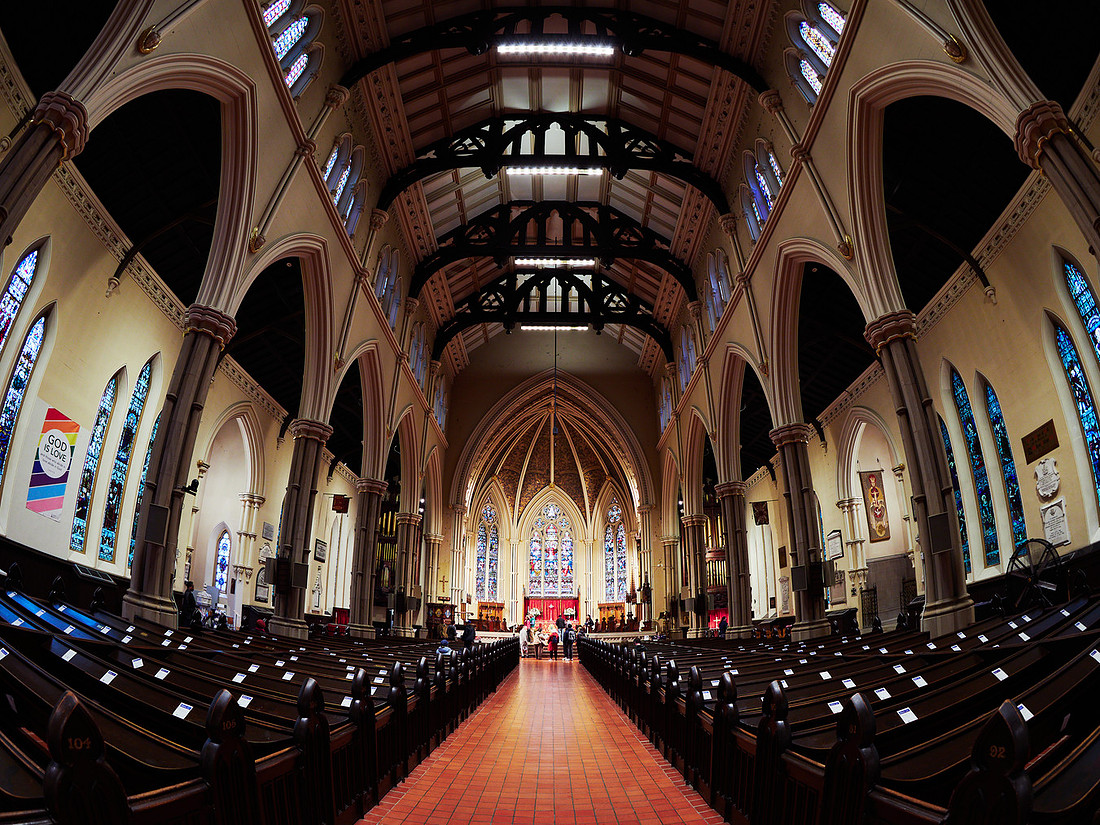 St. James Cathedral 1Carefully placing myself in the middle of the aisle, placing the top of the aspe in the exact centre of the frame, I lead the viewer toward the chancel, which was naturally the brightest part of the room to begin with, and with a fisheye lens it also becomes the least distorted and most real part of the room.
Of course, we do have the option to defish and remove the linear distortion, either in-camera or in post-processing. But doing so, comparing before and after, only made me more aware how distorted and misleading rectilinear ultra-wide angle perspectives can be in their own way. Although fisheye lenses might create images that seem wacky and surreal compared to rectilinear lenses, when used properly the fisheye effect can actually represent the subject and the scene more faithfully and bring the viewer closer to reality. And even if the image does not represent exactly what the viewer would be seeing if they were there, it might better represent what they would be feeling, standing in my shoes. Being able to quickly switch to a live preview of the defished result in-camera makes it much easier to compose and is very helpful in deciding which type of projection is the best for the scene.
St. James Cathedral 1Carefully placing myself in the middle of the aisle, placing the top of the aspe in the exact centre of the frame, I lead the viewer toward the chancel, which was naturally the brightest part of the room to begin with, and with a fisheye lens it also becomes the least distorted and most real part of the room.
Of course, we do have the option to defish and remove the linear distortion, either in-camera or in post-processing. But doing so, comparing before and after, only made me more aware how distorted and misleading rectilinear ultra-wide angle perspectives can be in their own way. Although fisheye lenses might create images that seem wacky and surreal compared to rectilinear lenses, when used properly the fisheye effect can actually represent the subject and the scene more faithfully and bring the viewer closer to reality. And even if the image does not represent exactly what the viewer would be seeing if they were there, it might better represent what they would be feeling, standing in my shoes. Being able to quickly switch to a live preview of the defished result in-camera makes it much easier to compose and is very helpful in deciding which type of projection is the best for the scene.
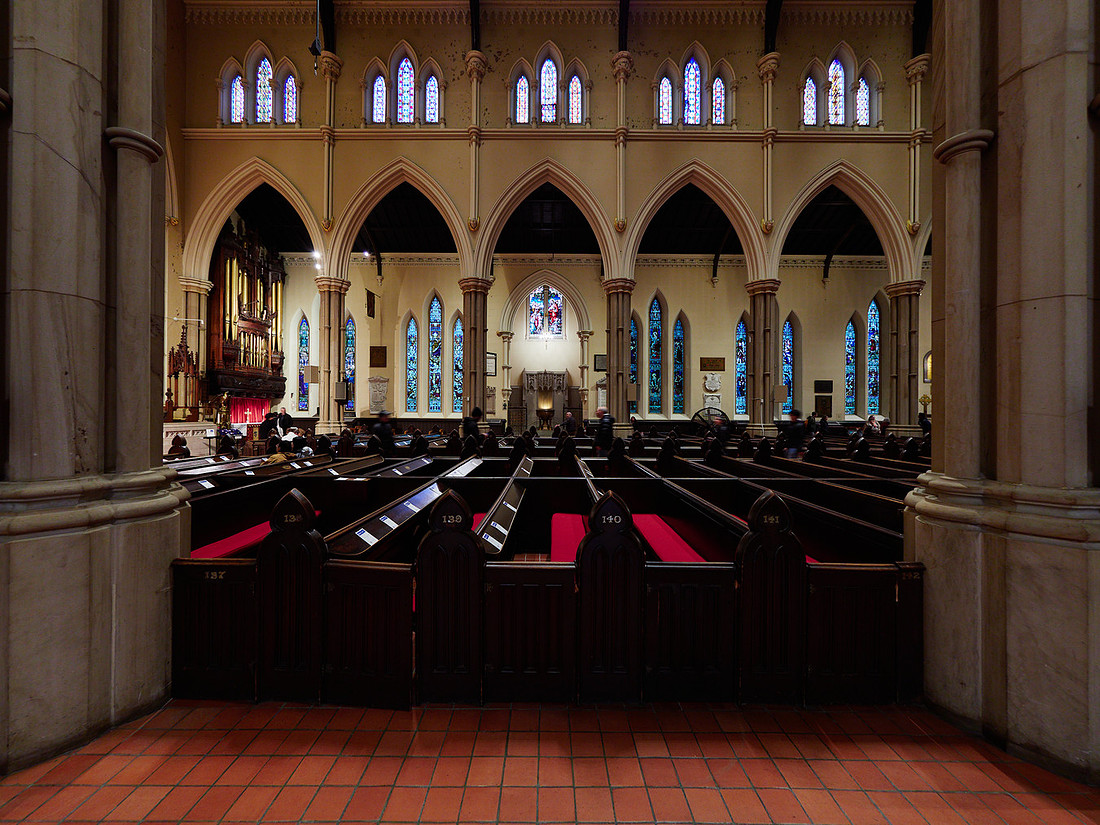 St. James Cathedral 3Defishing preserves are the regular patterns of vertical and horizontal lines which are important to the image. However, this also results in the pillars and tiles at the sides in the foreground becoming stretched out and greatly exaggerated in size.
I visited six buildings in total in downtown Toronto on a very rainy, windy, cold Saturday, May 23. These are the Thorton-Smith Building, St. George's Hall, TMU Architecture Building, Jarvis Street Baptist Church, St. Lawrence Hall, and the St. James Cathedral, in that order. Attending Doors Open is something I've been wanting to do for years but I kept putting it off or forgetting. Despite the weather (and my lack of sleep), I enjoyed the experience and appreciate the opportunity to photograph these places, and I look forward to it again next year. I also look forward to experimenting more with fisheye and I hope that detailing some of my experiences with this lens here will be helpful to others in some way.
St. James Cathedral 3Defishing preserves are the regular patterns of vertical and horizontal lines which are important to the image. However, this also results in the pillars and tiles at the sides in the foreground becoming stretched out and greatly exaggerated in size.
I visited six buildings in total in downtown Toronto on a very rainy, windy, cold Saturday, May 23. These are the Thorton-Smith Building, St. George's Hall, TMU Architecture Building, Jarvis Street Baptist Church, St. Lawrence Hall, and the St. James Cathedral, in that order. Attending Doors Open is something I've been wanting to do for years but I kept putting it off or forgetting. Despite the weather (and my lack of sleep), I enjoyed the experience and appreciate the opportunity to photograph these places, and I look forward to it again next year. I also look forward to experimenting more with fisheye and I hope that detailing some of my experiences with this lens here will be helpful to others in some way.
To see all my photos taken at Doors Open, both fishy and de-fished, visit the gallery page: Doors Open (2026)
The Epitome of Cookie-Cutter Suburbia: Corner Lots in Mississauga
One of the most common criticisms or stereotypes of suburbs and post-war urban development overall in the USA and Canada is their "cookie-cutter" nature. That is, the reuse of a particular design across multiple lots to save the developers money and to speed up development, particularly in places that are seeing rapid population growth. This may result in the lack of a sense of "place", which is the inability to distinguish one location from another. Correcting this is one of the main goals of "New Urbanism" championed by the likes of Andres Duany: building neighbourhoods centred around a particular landmark and embracing faux-historic architectural style to make them stand out.
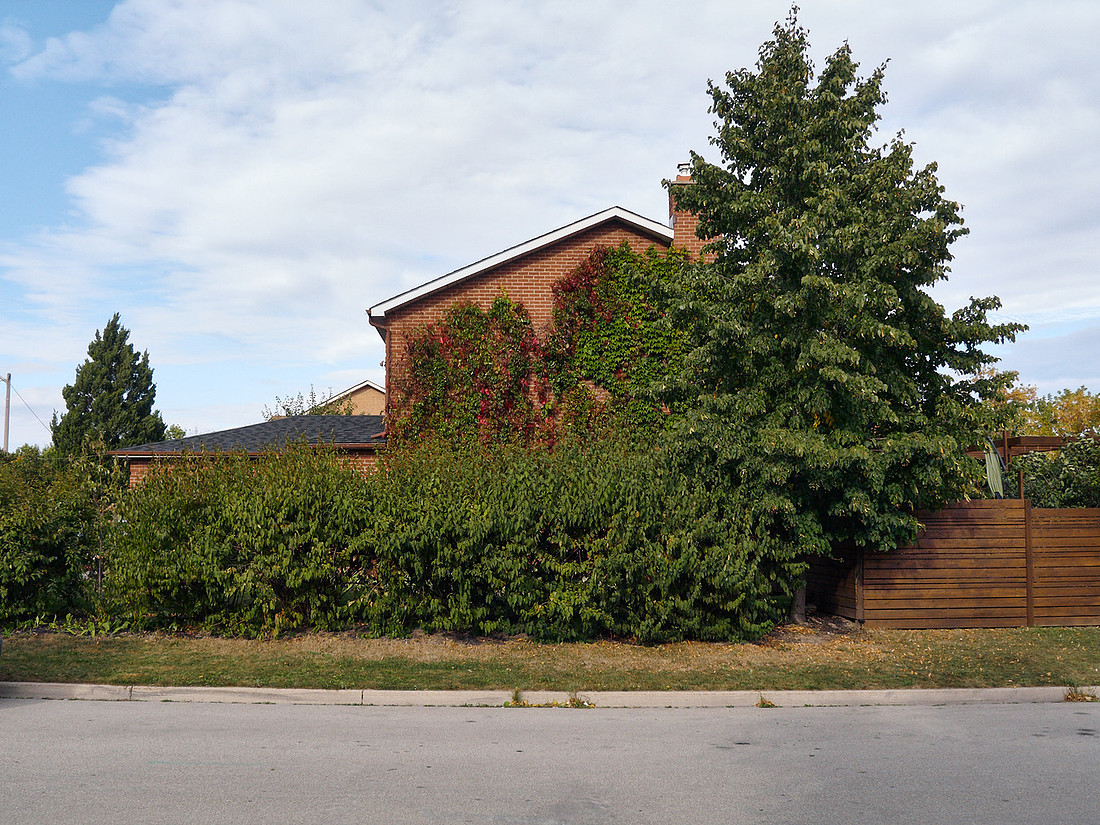
Personally, I am not sure how obvious or relevant it is or that a house on a small, quiet suburban street is of the same basic design as another further down the street, and it's not like entire neighbourhoods are being built by a single developer. Furthermore, there is no lack of repeating building designs in old pre-war neighbourhoods. That said, there are instances where the reuse of building designs are painfully obvious in the suburbs of Toronto, including my hometown, Mississauga, Ontario. I am talking about the houses on the corner lots:
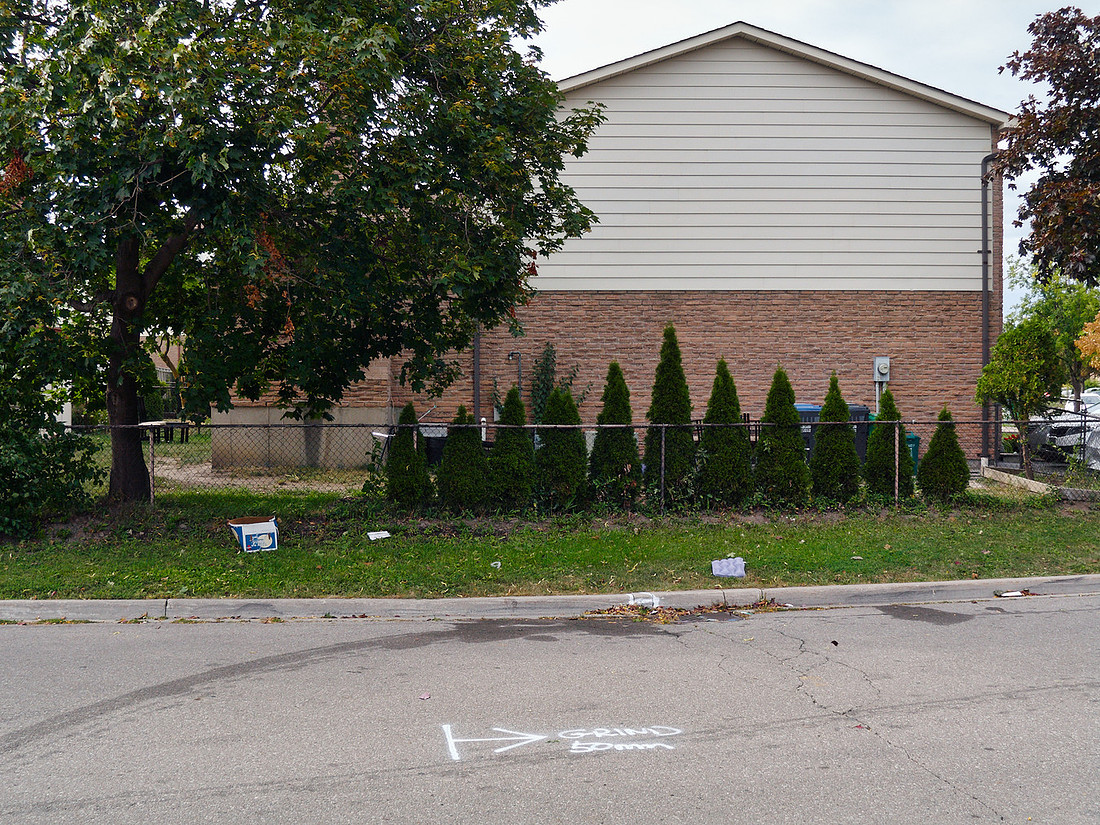
That's right, developers built so quickly and cheaply in this neighbourhood, they didn't even bother to come up one or two building designs specific to intersections to take advantage of the extra visibility and accessibility of the side of the building. No side doors, no extra windows, nothing but a blank wall. The houses at these street corners look no different than the other houses. As a result, the intersections, which connect streets and neighbourhoods, where people come together, where people's paths cross, what should be most identifiable locations and help people find their way around, lack that sense of "place."
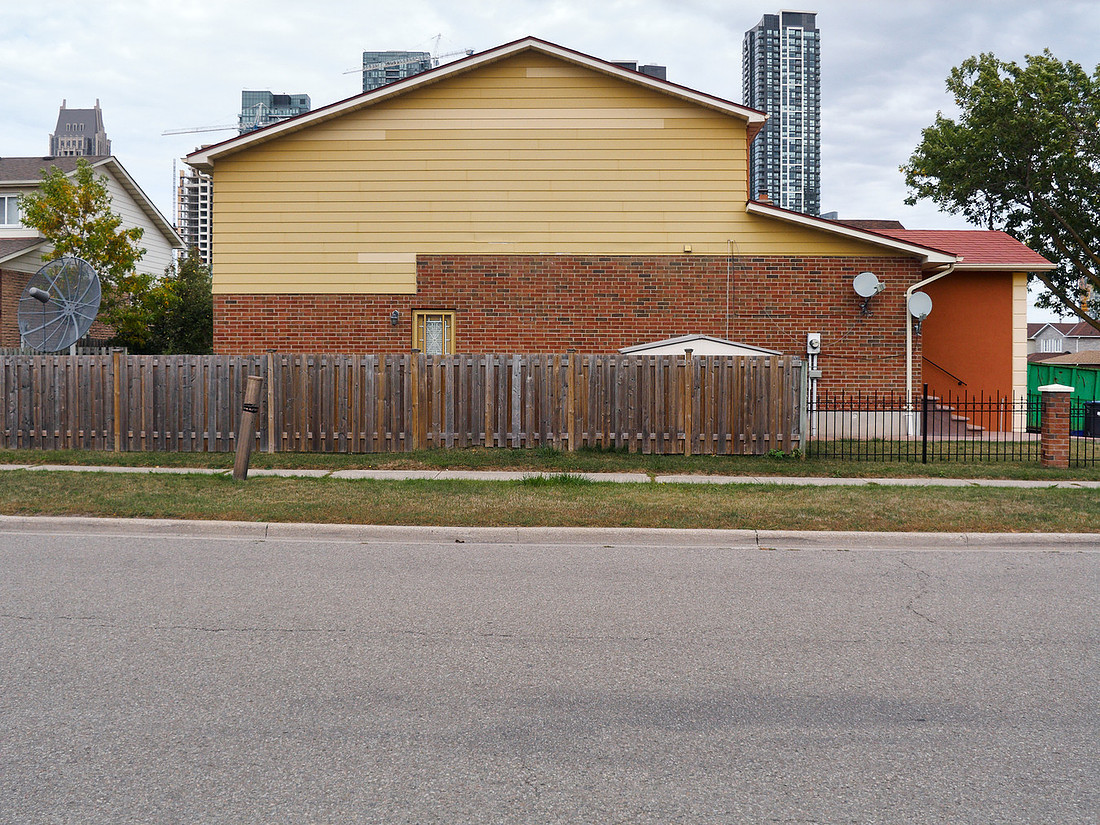
Maybe you don't need a landmark or kitschy, faux-historic New Urbanist architecture to add a sense of place. Maybe it's as simple as building some houses with designs that take advantage of corner locations. Extra windows, a side entrance instead of front entrance, an extra walkway, these are little details, but they can make a big difference. The attention to details, that is what makes a place truly stand out and gives it character. Of course, some residents of these houses try to add their own sense of place, give their unique touch to their lot, but perhaps it makes the flaws all that more glaring:
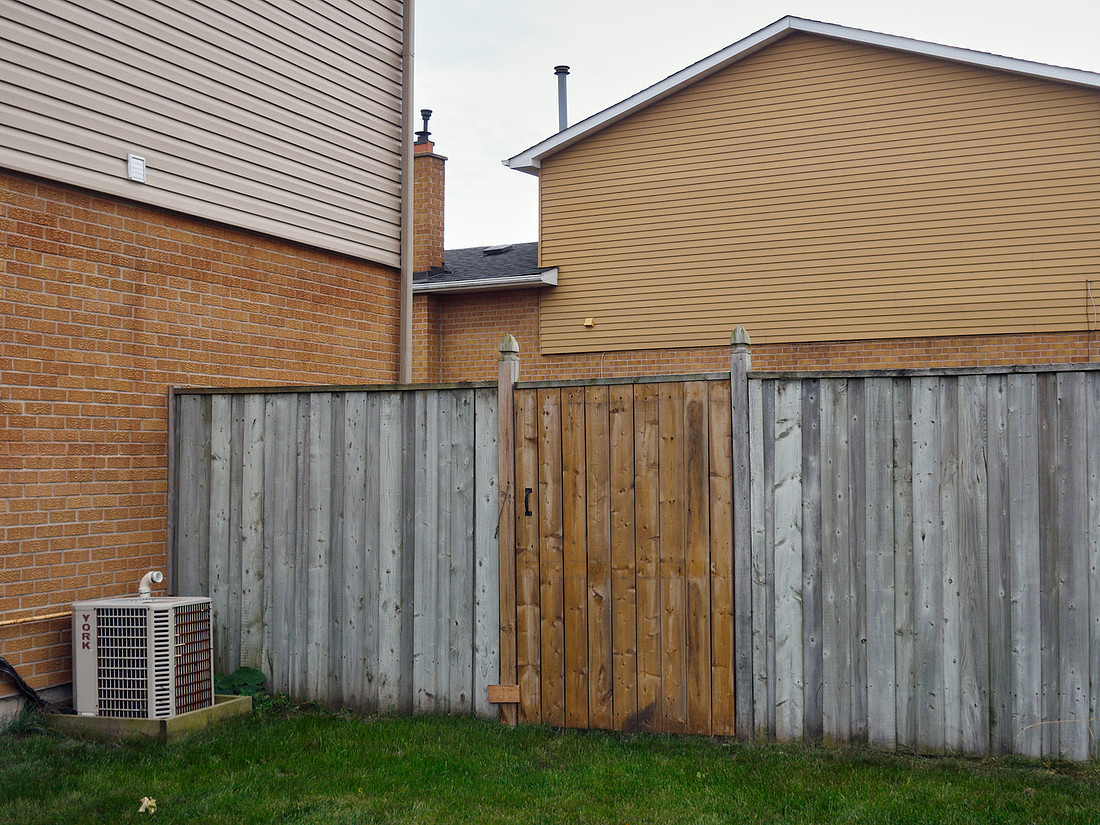
Of course, one might ask, even if the house isn't on a corner lot, shouldn't it still have windows? And that might be a good question. Honestly, I live the end unit of a townhouse in another part of Mississauga, it's not a corner lot, and it has five side windows. So why developers would build a single-family, detached house with no side windows confuses me as well. It seems that not only are developers unconcerned about a better public realm, but they also seem unconcerned about better private living spaces.
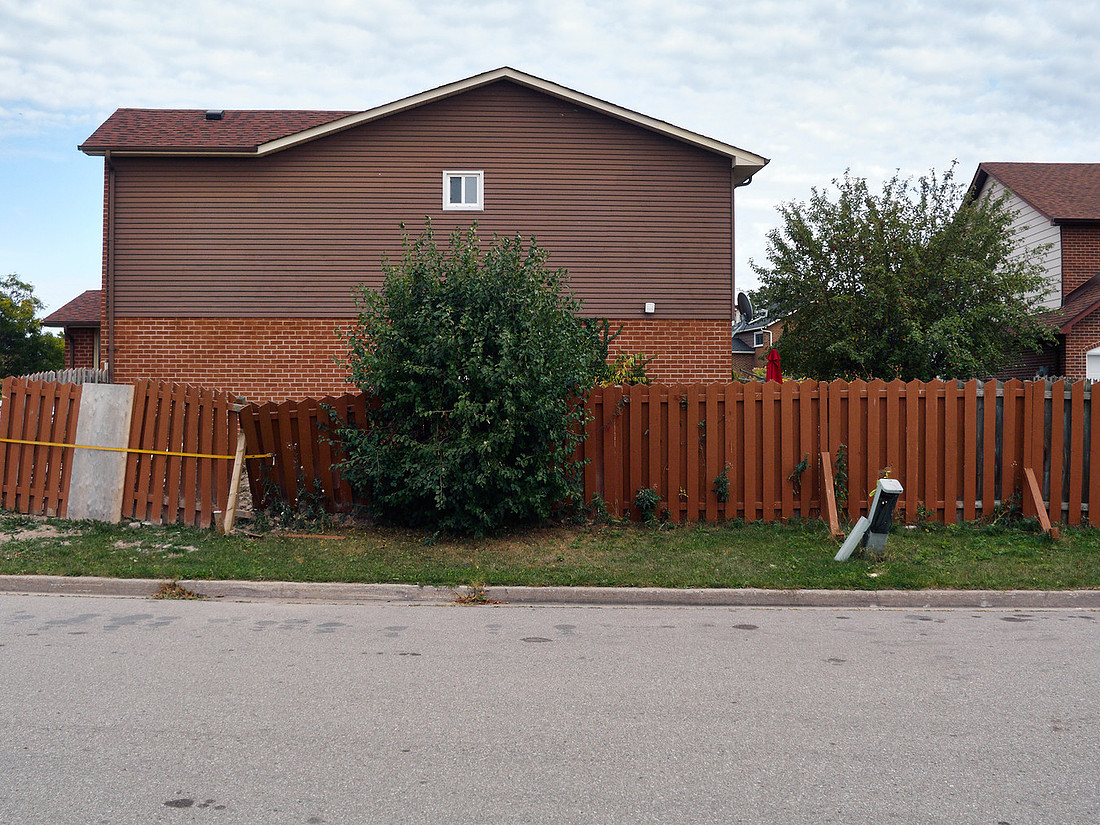
I think the real question is not why developers build houses this way, but rather why governments allow them to build houses this way. High housing costs are blamed on "red tape" and restrictive government policies. Less government intervention is the solution to high housing costs, politicians like Doug Ford argue. Is government intervention to blame for the "shoebox condo"? Well, you can look these photos and the rest of the series and decide for yourself whether more developer freedom and fewer government regulations would be good for aspiring homeowners.
For the the full series, visit: Corner Lots.
Death of a Mall: Sarnia's Bayside
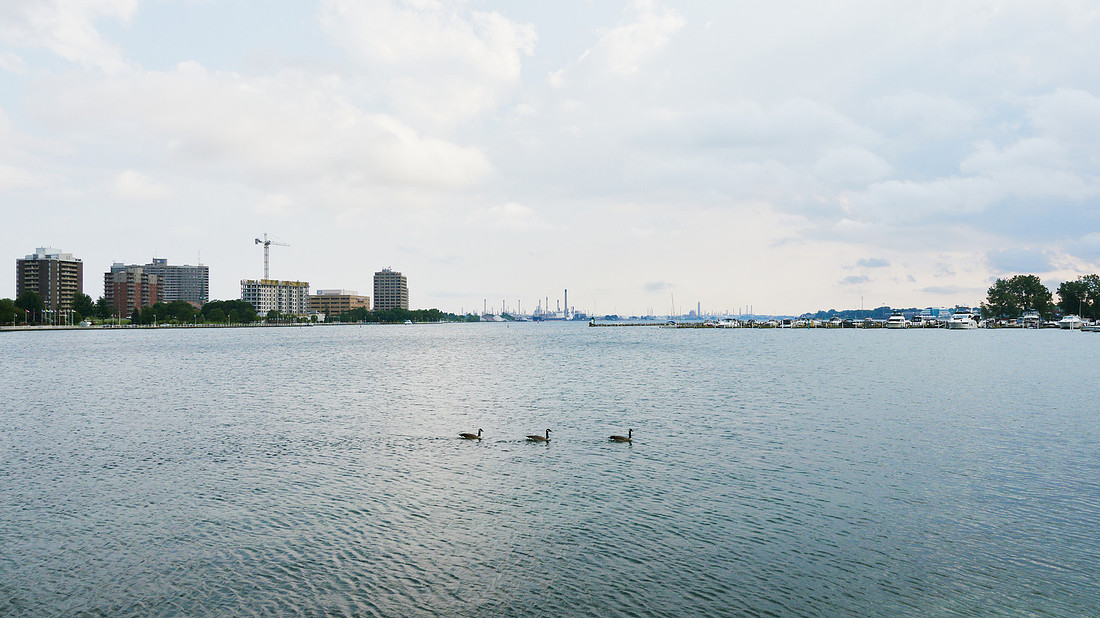 Looking out from Sarnia Bay towards downtown and Chemical Valley, on July 29, 2021.
The indoor shopping mall located in the heart of downtown Sarnia, Ontario opened in early 80s as Sarnia Eaton Centre, and was later renamed to Bayside Mall after the demise of Canadian department store chain, Eaton's, and then to Bayside Centre before its demolition in 2021. It is a common story throughout Canada and the USA: big box retailers kill department stores, and the malls once anchored by these department stores die along with them. The death of these malls often results in conversions to even more pedestrian-unfriendly power centres (aka. "demalled").
The story of Bayside Centre is unusual because it is also part of the story of a downtown, representing the resilience of traditional main street retail and independent, local business rather than the triumph of big box retail chains (perhaps the presence of the much larger Lambton Mall on the outskirts of the city didn't help either). And instead of being converted into yet another horrible power centre and reinforcing car culture, the demolition of Bayside Centre is opportunity for urbanization, intensification, and promoting walkability of a historic city centre.
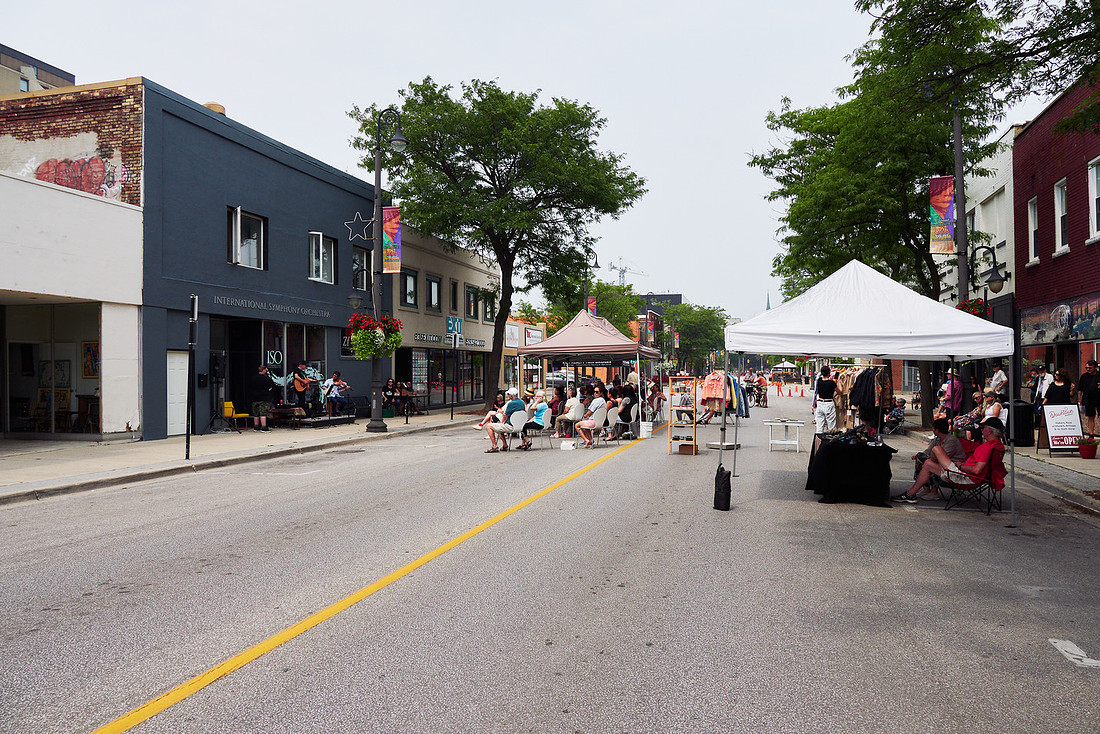 Weekend Walkabout on Christina Street in Downtown Sarnia on July 24, 2021.
Sarnia's downtown might not be as big or as well built up as one might expect for that of a city of over 70,000 people. Not enough of the vibrancy of a city, and not enough of the charm of a small town, it is situated in an awkward position. It does feel like a place that is stuck in time, perhaps held back by the presence of the mall. It probably doesn't help that the downtown and the mall are not actually located bayside. Sarnia Bay, the part of the waterfront where the locals gather, actually lies further upstream to the north. To the east, the mall noticeably disrupts the downtown street grid, with Lochiel Street broken up into two parts. Where Lochiel Street once ran became the main front and rear entrance to the mall, adjoining the Eaton's store. Fittingly, this was the first part of the mall that was demolished.
Weekend Walkabout on Christina Street in Downtown Sarnia on July 24, 2021.
Sarnia's downtown might not be as big or as well built up as one might expect for that of a city of over 70,000 people. Not enough of the vibrancy of a city, and not enough of the charm of a small town, it is situated in an awkward position. It does feel like a place that is stuck in time, perhaps held back by the presence of the mall. It probably doesn't help that the downtown and the mall are not actually located bayside. Sarnia Bay, the part of the waterfront where the locals gather, actually lies further upstream to the north. To the east, the mall noticeably disrupts the downtown street grid, with Lochiel Street broken up into two parts. Where Lochiel Street once ran became the main front and rear entrance to the mall, adjoining the Eaton's store. Fittingly, this was the first part of the mall that was demolished.
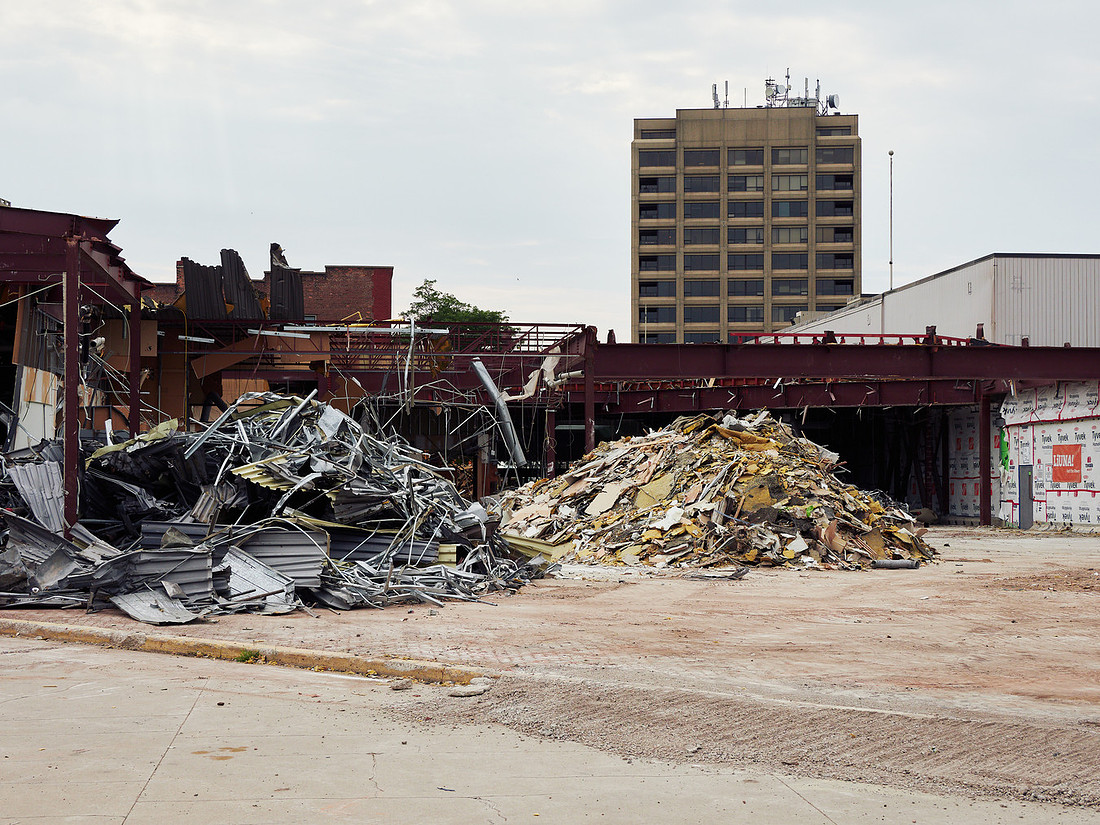 The demolished rear entrance of mall, on July 22, 2021.
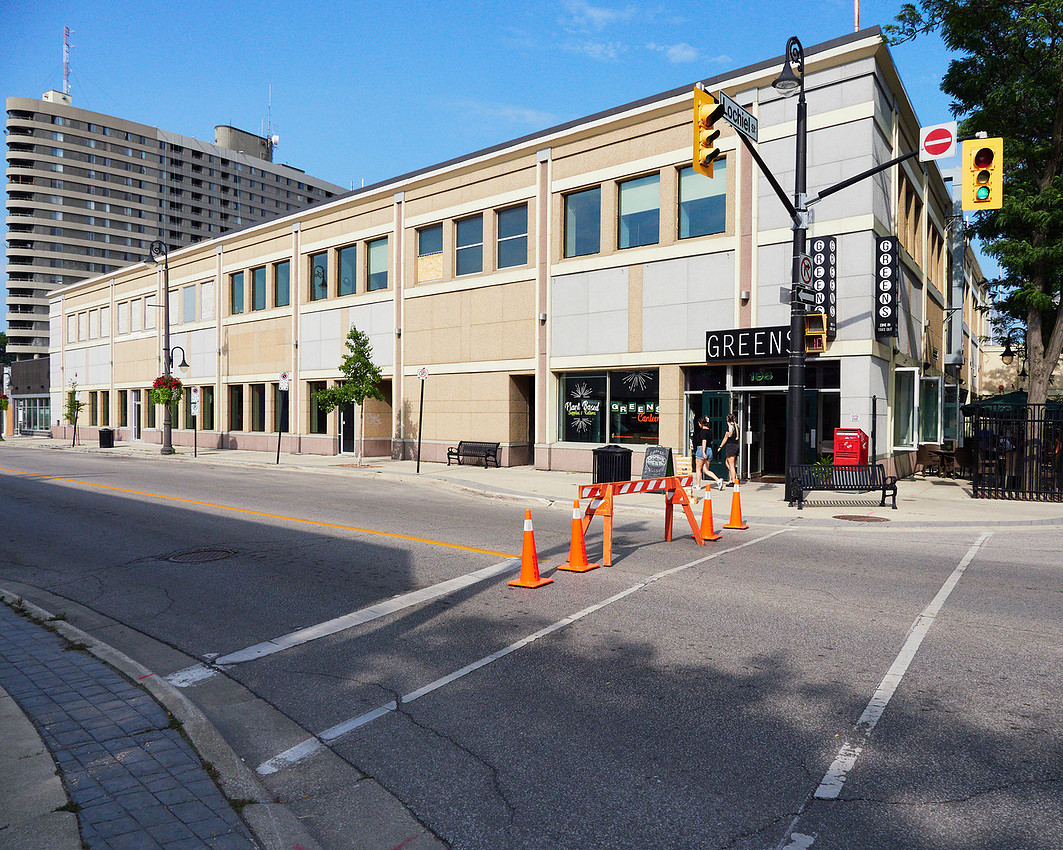 The former Eaton's location, on July 23, 2021.
Not all of the mall will be demolished, however. The former Eaton's store (pictured above) facing the west side of Christina Street, the main street of Sarnia, was in the process of being converted into a standalone building. It was being renovated and subdivided into multiple retail units, which had yet to be filled at the time I was there.
The former Eaton's location, on July 23, 2021.
Not all of the mall will be demolished, however. The former Eaton's store (pictured above) facing the west side of Christina Street, the main street of Sarnia, was in the process of being converted into a standalone building. It was being renovated and subdivided into multiple retail units, which had yet to be filled at the time I was there.
What exactly is to become for the rest of the mall property? I asked this question to one of the locals and they told me that a retirement home is be built, which surprised me. Searching online I can confirm that the land is owned by an Oakville-based company, Seasons Retirement Communities, but their plans have stalled. When I returned to the city the following year, I did see some small government office buildings had been built on the north side of the site directly behind the former Eaton's. Hopefully, the rest of the site gets redeveloped soon to bring more people into downtown Sarnia and support its small businesses.
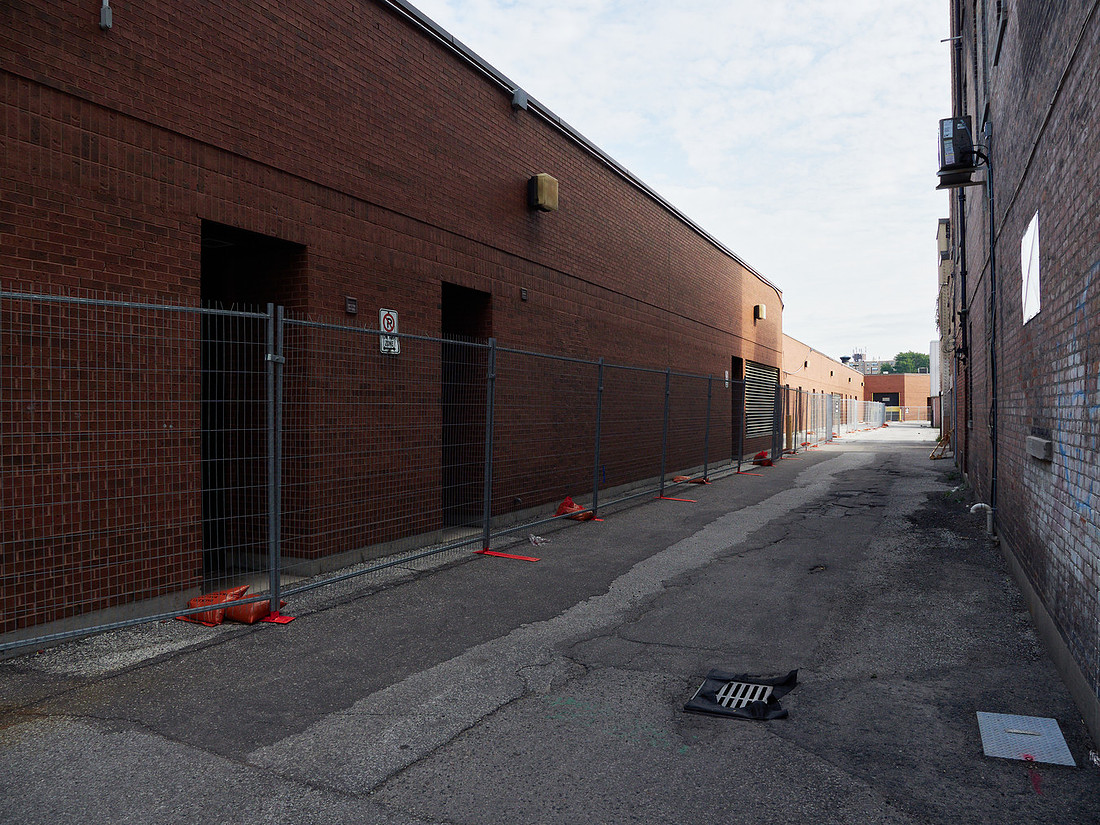 Seaway Lane separates the mall and the historic structures on the west side of Christina Street.
On July 29th, I arrived at the main entrance to the mall to find that Lochiel Street had been closed off with red ribbon at Christina Street, so I assumed demolition was going to happen sometime that day. Not knowing the exact time, I wandered around town for a bit, and unfortunately I arrived a little late and missed the beginning of the demolition. And I didn't stay for as long as I wanted to either because as the mall crumbled it filled the air with dust. All over my clothes, my camera, my lens. In panic, I actually retracted the extended barrel of my lens when it was still covered in dust, which only made me even more panicked.
Seaway Lane separates the mall and the historic structures on the west side of Christina Street.
On July 29th, I arrived at the main entrance to the mall to find that Lochiel Street had been closed off with red ribbon at Christina Street, so I assumed demolition was going to happen sometime that day. Not knowing the exact time, I wandered around town for a bit, and unfortunately I arrived a little late and missed the beginning of the demolition. And I didn't stay for as long as I wanted to either because as the mall crumbled it filled the air with dust. All over my clothes, my camera, my lens. In panic, I actually retracted the extended barrel of my lens when it was still covered in dust, which only made me even more panicked.
Luckily, both my Olympus E-M1 Mark II and 12-100mm f/4 IS PRO are dustproof. The main reason I bought this combination in late 2019 was for a trip to Vietnam, which got cancelled due to the COVID-19 pandemic a few months later. I didn't think I would need the weather-sealing and dust-sealing in Sarnia. It was very fortunate because this dust would have destroyed my previous camera and/or made me miss capturing this potentially defining moment in Sarnia's history.
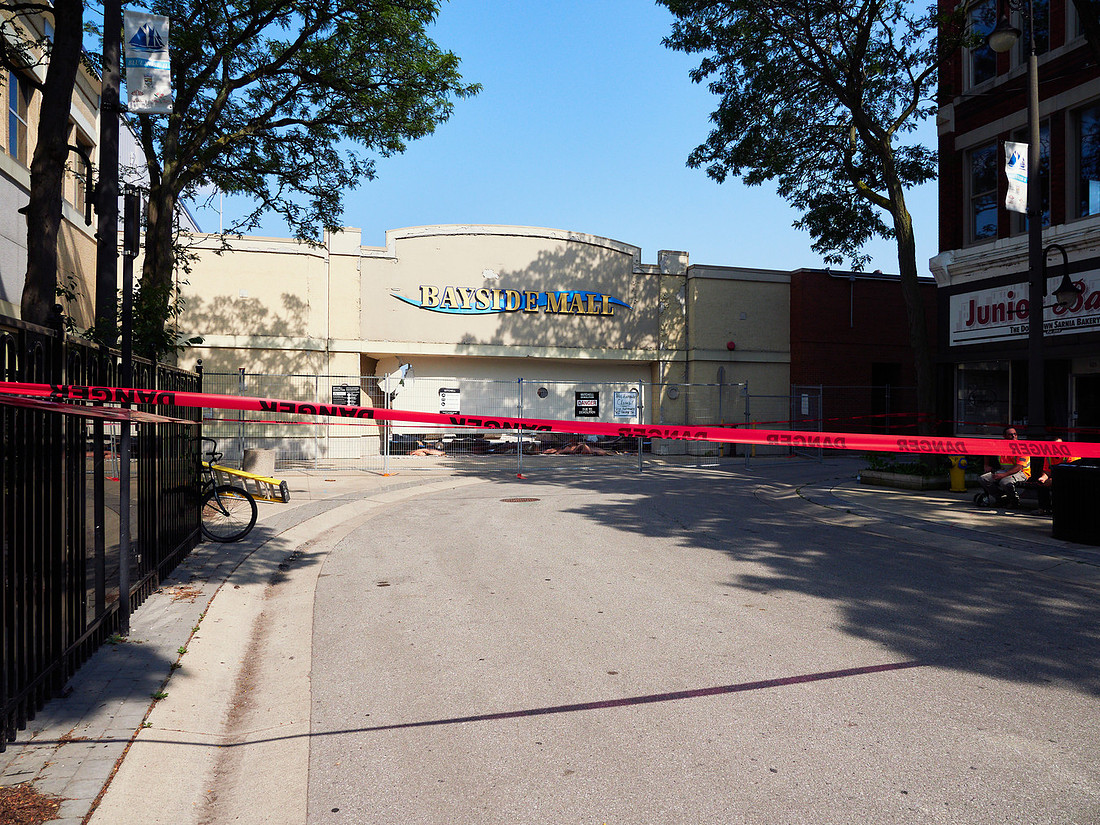 Access to Lochiel Street and the front entrance of the mall closed at 4:51PM EDT on July 29, 2021.
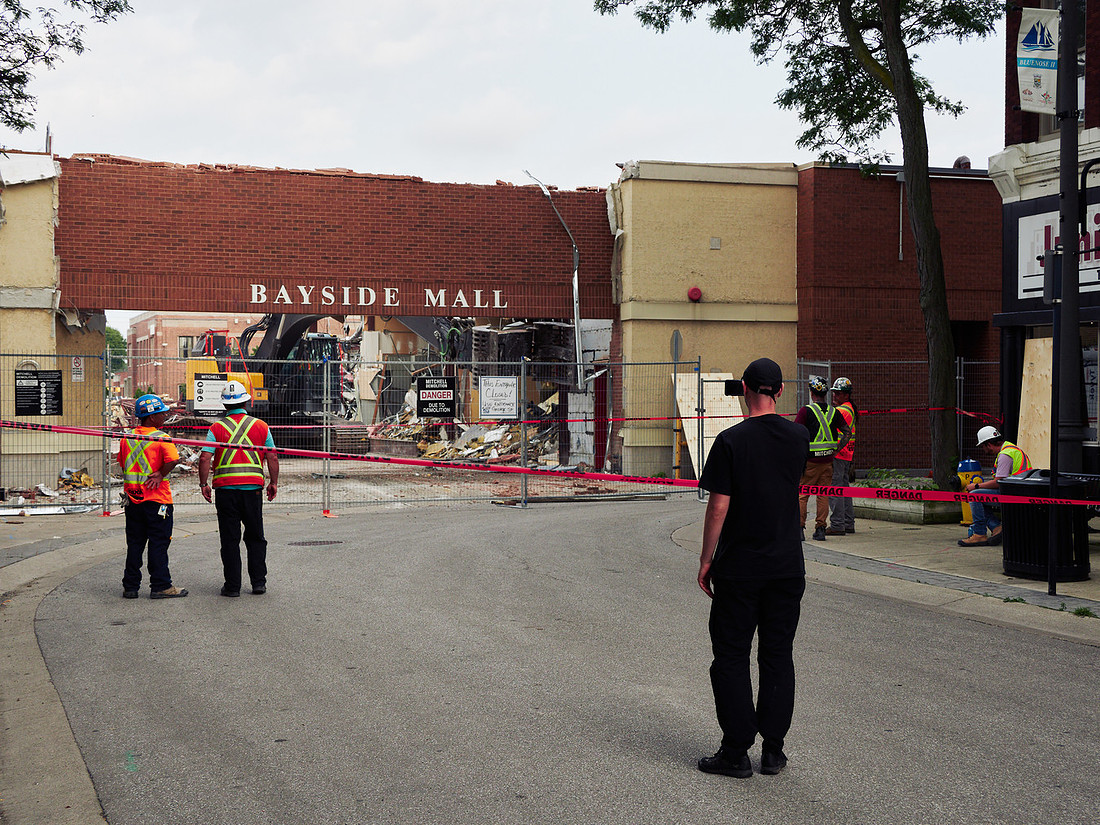 Demolition at 6:35PM EDT.
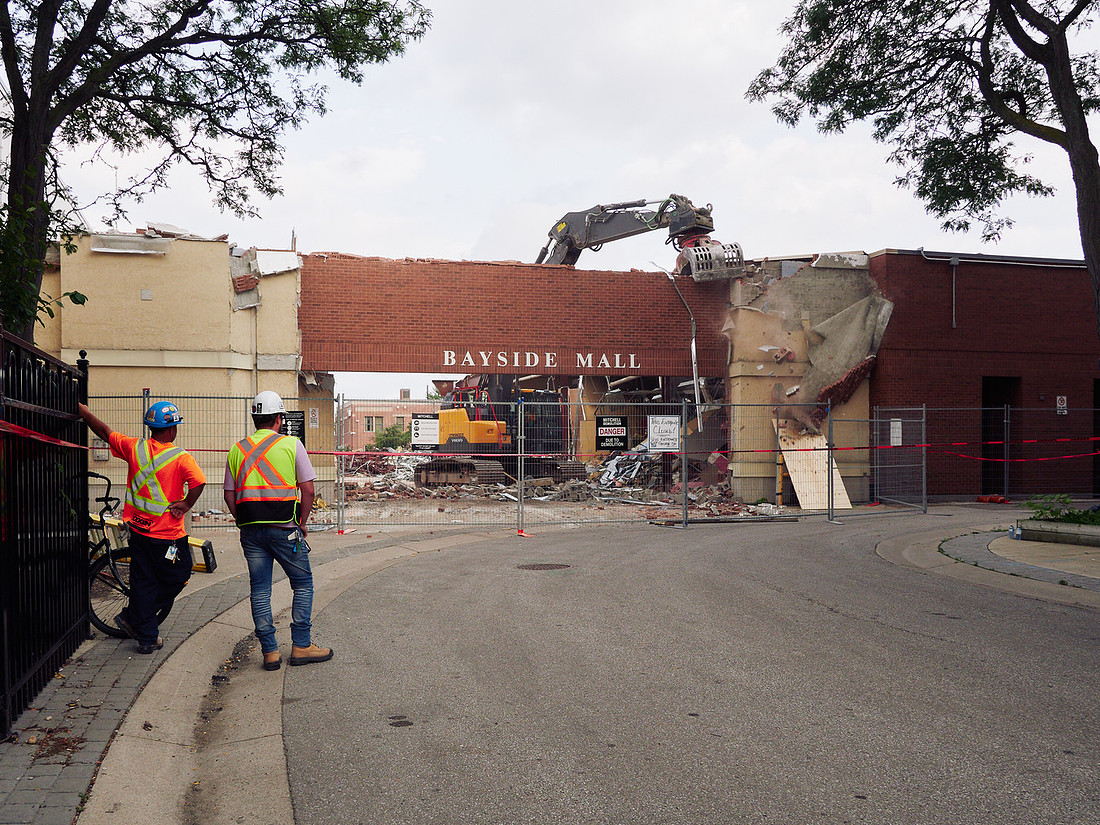
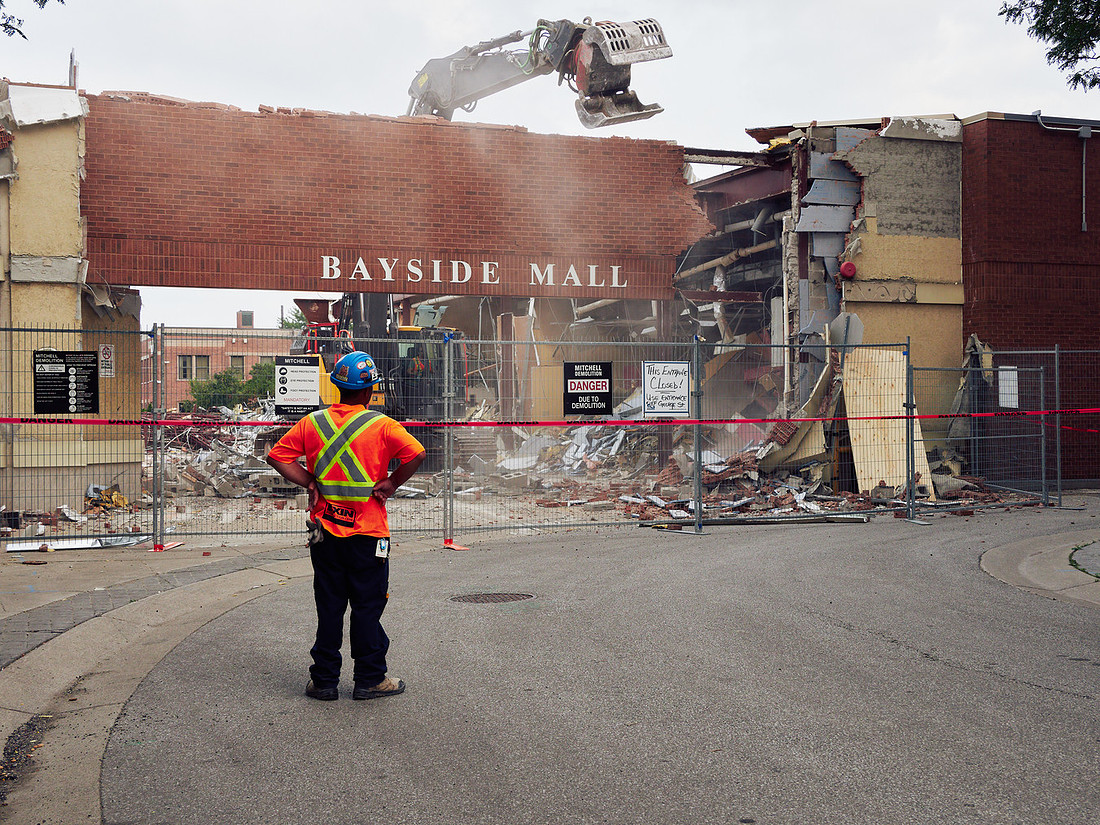
If you are interested in seeing the rest of the photos in this series, please visit Sarnia: Bayside in my gallery.
At Home He's a Tourist: The U.S. Invasion of Canada
At home he feels like a tourist
He fills his head with culture
He gives himself an ulcer
- Gang of Four, "At Home He's a Tourist"
Much has been said about U.S. president Trump's open threats to annex Canada, calling it the "51st state", mockingly referring to the prime minister as "Governor Trudeau", applying pressure to Canada with tariffs, but something that has been less talked about is how much of Canada that the U.S. has already taken over. From our businesses, our products, our politics, how much of what we do and consume is dominated or influenced by the U.S.
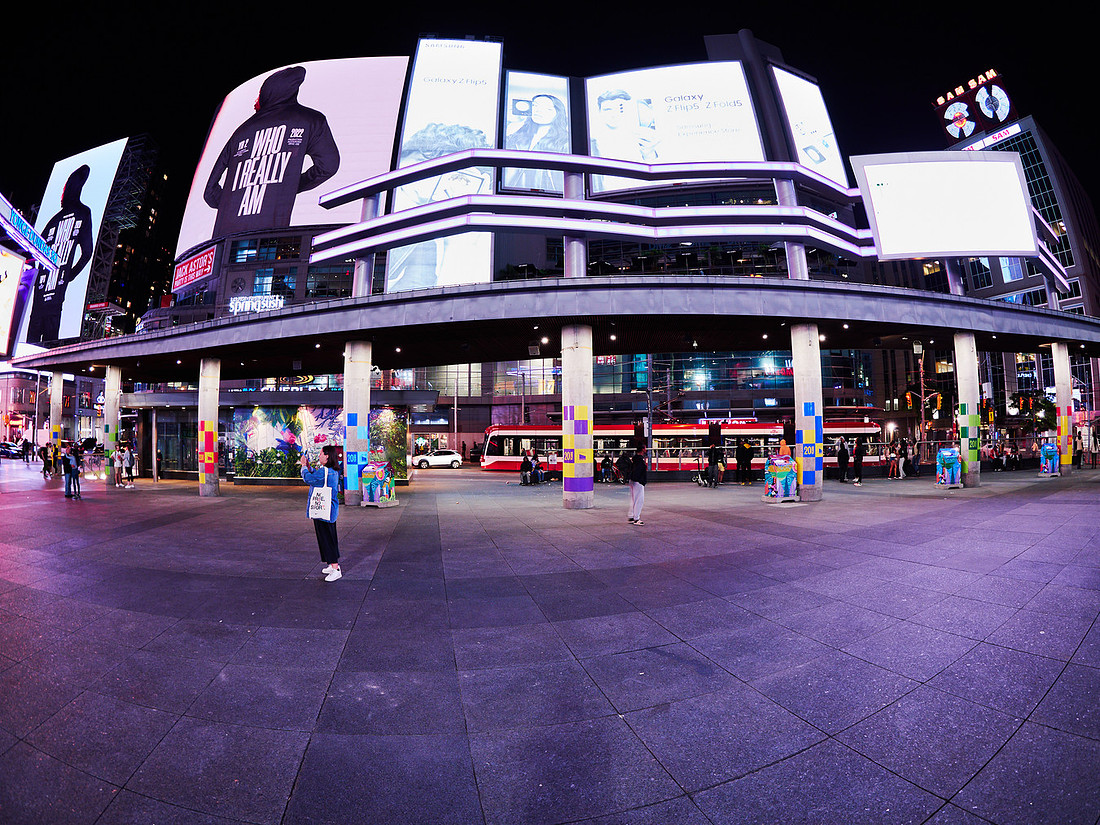 At Home He's a Tourist 9Yonge-Dundas Square
There is no better example of the pervasive U.S. influence than Yonge Street in Toronto. This is the main street of Canada's largest city, the country's most famous and iconic street, so surely not only should it represent what Toronto is all about, it should also reinforce the Canadian identity. Someone walking down Yonge Street should get a taste of Toronto's culture, and by extension a taste of Canada's culture. Yonge Street should be a place that is special and unique to Toronto, showing people and reminding people, whether they are Canadian or not Canadian, what being a Torontonian and what being Canadian really means. And yet...
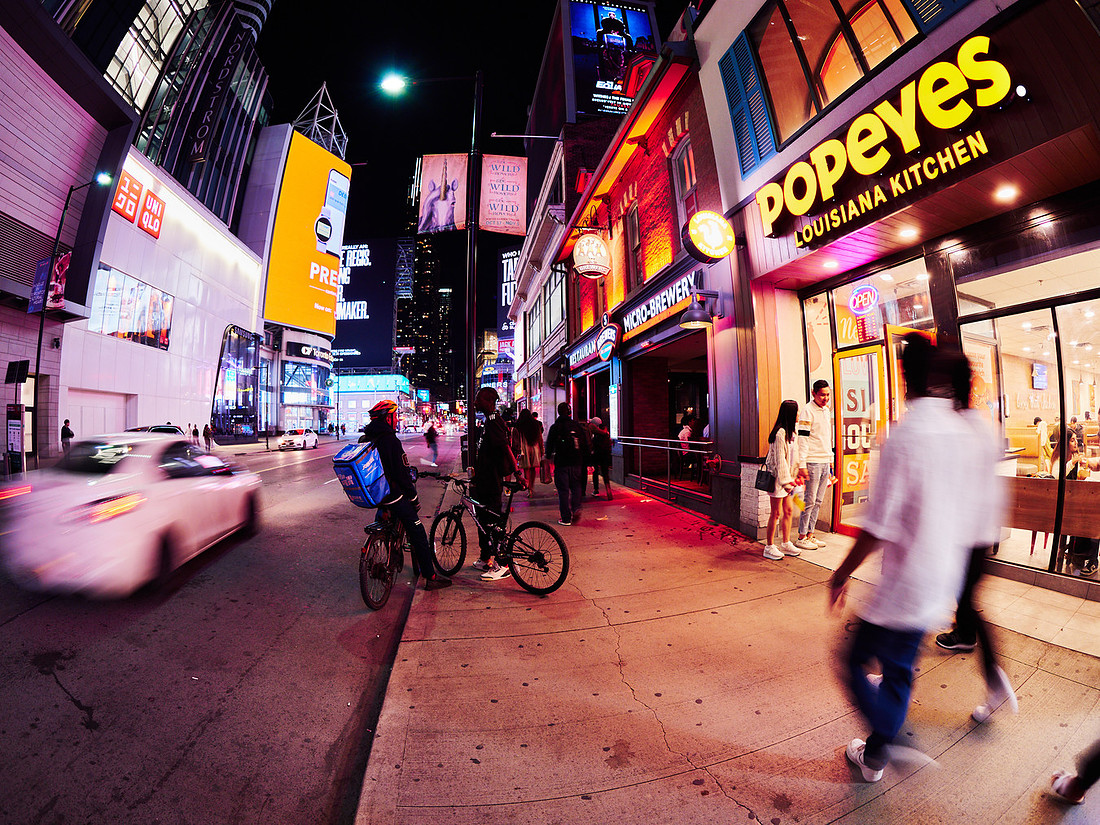 At Home He's a Tourist 7Outside the Eaton Centre
While this all may have been true in the past, you will find very little of what makes Toronto "Toronto" or Canada "Canada" remaining along Yonge Street in the downtown core. Many of those locally-owned, mom-and-pop shops have long been replaced multi-national retail and restaurant chains. The U.S. brands especially dominate the streetscape today. The American tourist visiting Toronto may as well have just stayed home. After all, they don't get a taste of Toronto or Canada by eating at another Popeyes. And the European tourist may as well have just gone to the U.S. instead to get a true taste of U.S. culture (assuming they are not concerned about being arrested, imprisoned, and deported by US border control).
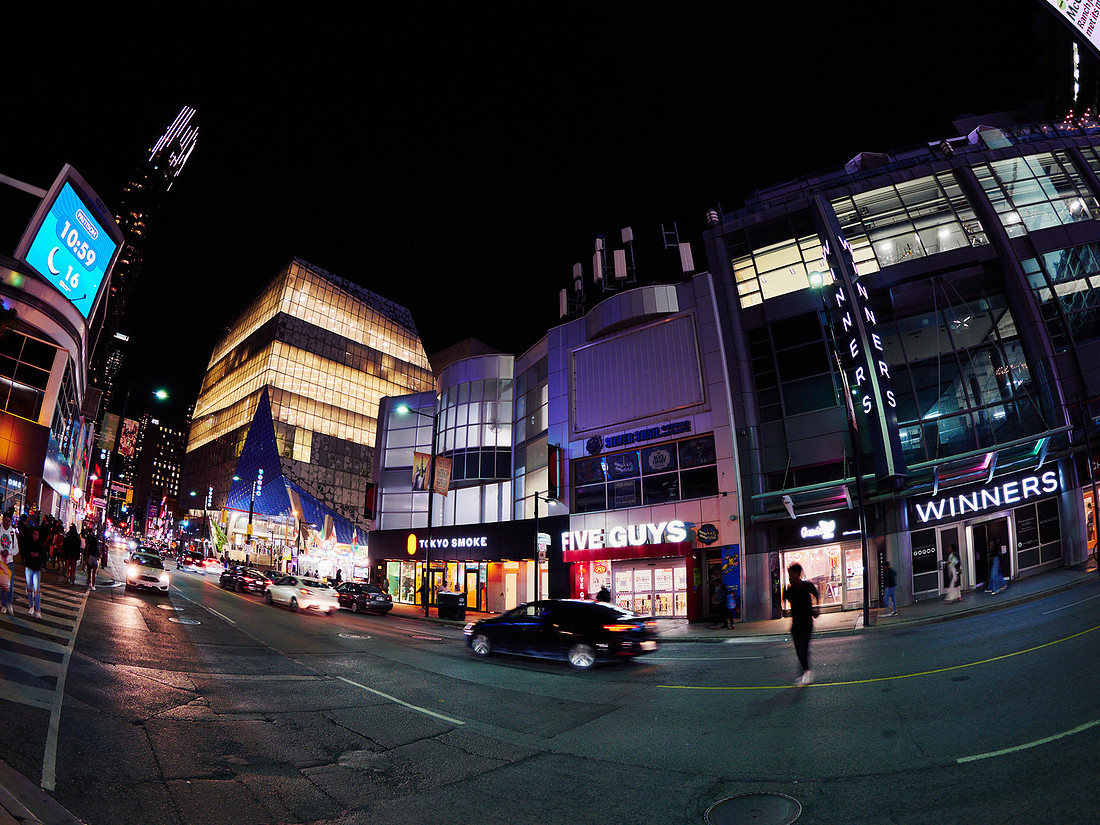 At Home He's a Tourist 14Yonge north of Dundas
Of course, the real dilemma here is for Canadians, especially Torontonians. If even Yonge Street of all places has become "Americanized", robbed of all its identity, then what about the rest of the city? What about the rest of Canada? Where can we experience the true Toronto? What does it really mean to be Canadian nowadays? In response to Trump's tariffs, there has been a growing "Buy Canadian" movement, but it could be more difficult to follow than most Canadians realize.
But perhaps it will serve as a wake-up call and reminder of how important it is to support local, independent businesses. And when I say local and independent, I don't just mean Canadian. Because this is not really about Canada. In this particular example, it's really about Toronto. And this should be also be a wake-up call to people outside of Canada. Wherever you live, whether it be in Canada, the U.S.A., the U.K., France, Germany, etc., don't just think about your country, think about your city.
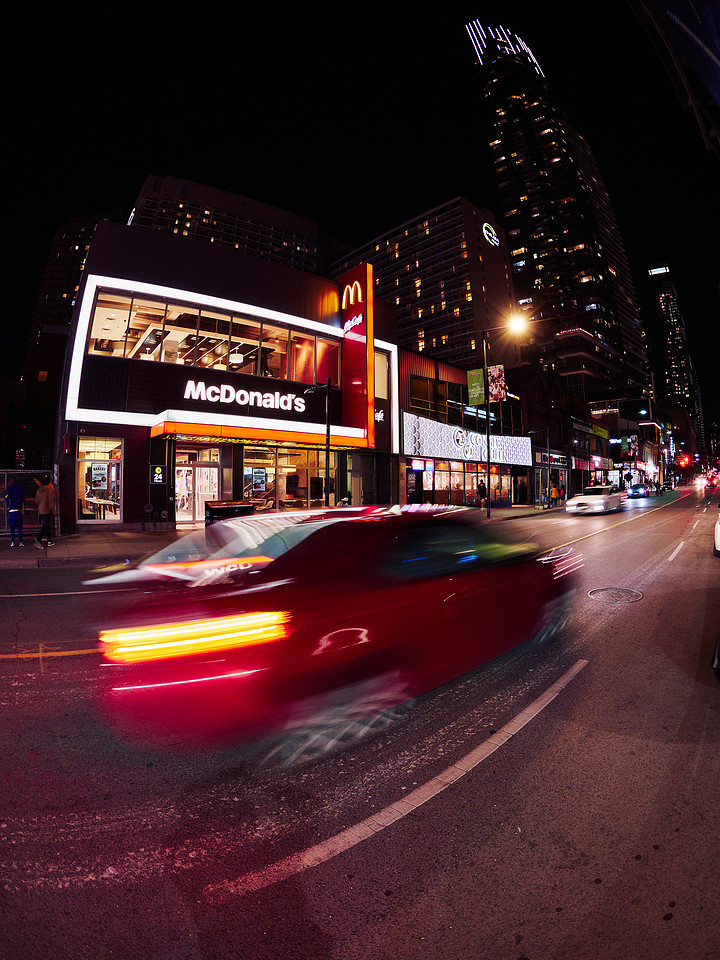 At Home He's a Tourist 16McDonald's at 356 Yonge St.
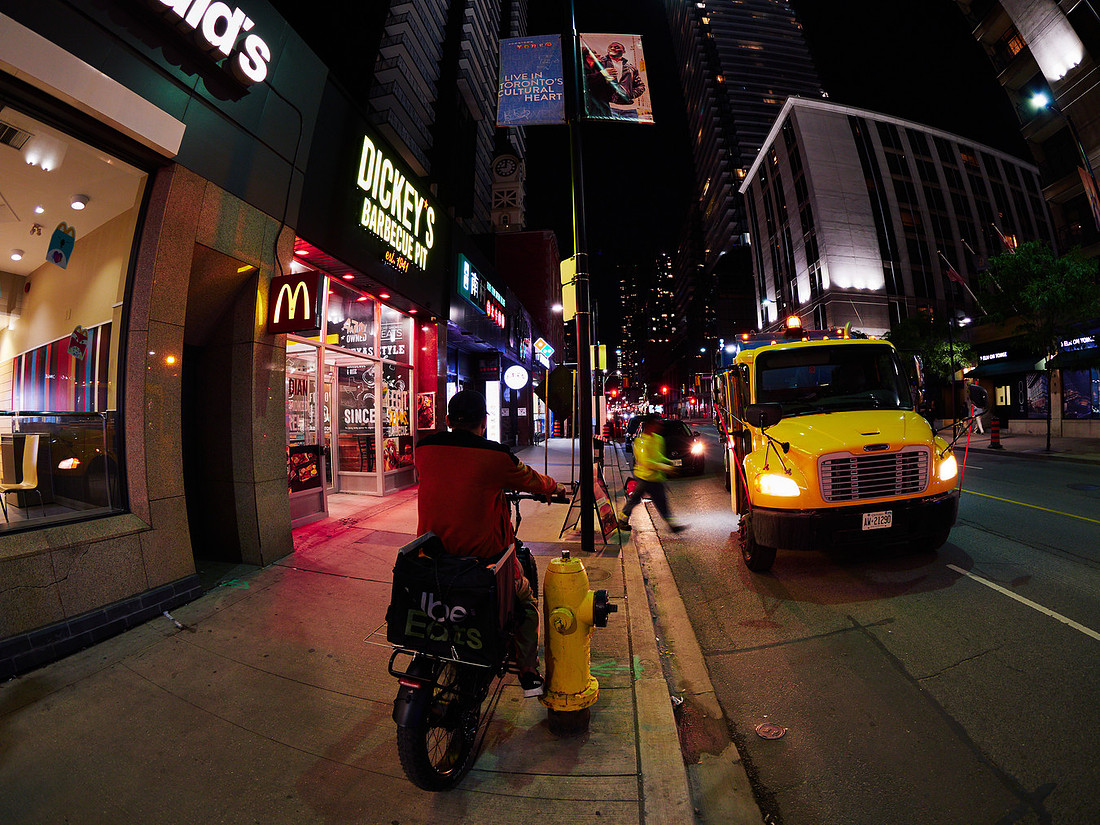 At Home He's a Tourist 21McDonald's at 470 Yonge St.
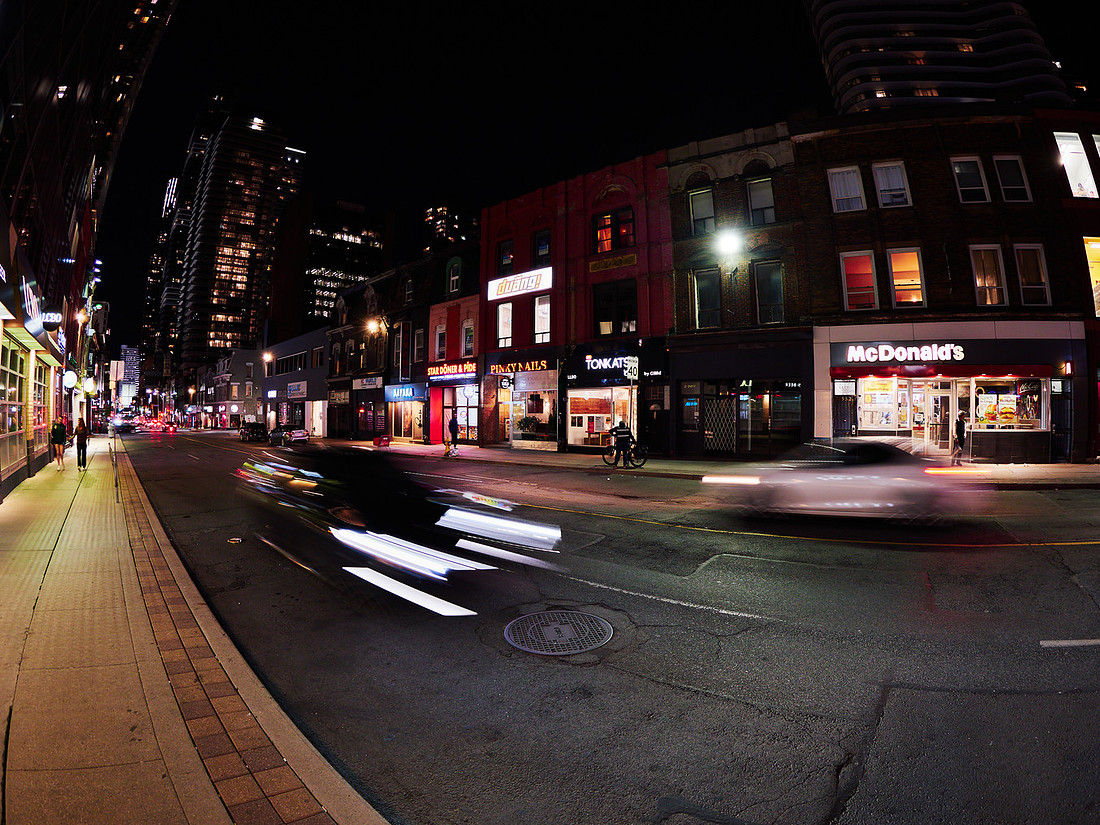 At Home He's a Tourist 25McDonald's at 552 Yonge St.